1. natasha 饭姐
    natasha   回复文章

    【國安法第一案手記】“时代革命”含有港独的意思吗?

    @猫宅冻 #149392

    有关光复的意义,控方专家认为光复有夺回政权之义,这个意思自古以来从未变化。而辩方专家从元朝的文献中,找出元朝皇帝曾经说过:光复祖宗之业“。皇帝不可能推翻自己祖宗建立的政权,因此光复亦带有振兴和恢复秩序的意义。

    因此,光复并非只有单一的夺回政权的意思。

    此外,辩方专家还从社会统计学角度,对2600万条网络留言进行了分析,认为光复与独立关联不大。

    当然,每个人心中都有自己对于光复的解释,自己认为光复就是夺回政权也无可厚非。

    但在法庭上,辩方的意图在于为被告脱罪,立场是光复与颠覆政权无关。而且,这一案子牵扯到几十甚至上百被控违法国安法的人的前途,越能证明光复与颠覆政权无关越好。

    强烈建议您阅读 /t/13553/t/13586

  2. 老鼠与毒药   回复文章

    精神发布会“河南抗洪抢险精神”

    从去年开始就各种精神,我只想说一句:

    “好,很有精神!”

  3. 庆丰话   回复文章

    一尊去哪儿里了?

    内容已删除
    内容已被作者本人或管理员删除。 如有疑问,请点击菜单按钮,查看管理日志以了解原因。
  4. 爱狗却养猫 饭丝
    爱狗却养猫   回复文章

    一尊去哪儿里了?

    一尊去了青藏高原:https://www.rfi.fr/cn/專欄檢索/要聞分析/20210722-萬目矚目河南洪災-習近平卻去了拉薩

    藏人行政中央駐台代表格桑堅參22日接受自由亞洲電台採訪表示,日前從西藏境內傳出消息,21號到27號之間,在拉薩上空要進行空中禁飛,以及要突然關閉布達拉宮。從這些跡象基本上可以斷定,這兩天中共總書記應已到了拉薩。

    境內藏人傳出數張照片和視頻還顯示,習近平已經抵達拉薩。習近平從拉薩朵究倉藏裝店步出,也在八廓大昭寺外,大批侍衛護衛下向尖叫的群眾們揮手,及在一個廣場上發表簡短講話。不過,中國的媒體沒有報道。

  5. 爱狗却养猫 饭丝
    爱狗却养猫   回复文章

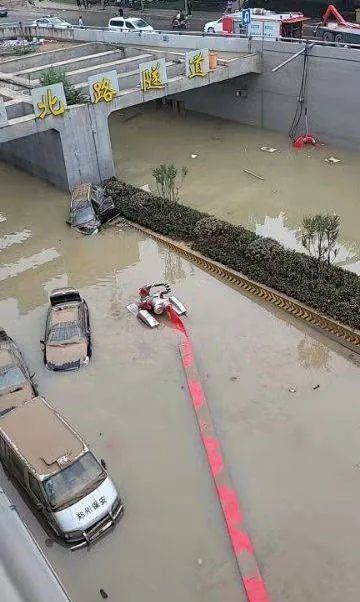
    【极昼工作室】京广路隧道的生死十分钟

    为死难者默哀。

    有决断弃车而逃的人,值得佩服,值得学习。

  6. 爱狗却养猫 饭丝
    爱狗却养猫   回复文章

    【极昼工作室】京广路隧道的生死十分钟

    隧道里有多少车/多少人?(update)

    京广隧道主要有南路北路两段;双向六车道。南路隧道据说由于积水7.20上午已经封闭。北路隧道当时有一个方向在堵车,据幸存者口述,拥堵时间至少有一个多小时,其间有些车主已经弃车离开。北路隧道的另一个方向似乎能够正常行驶。

    北路隧道地下长度1360米;假设隧道前后两百米的人都能顺利逃生,则被陷长度为960米。假设堵车中平均车身长度5米,车距3米,则拥堵方向被困车辆为360辆;正常行驶方向车距15米,则被困车辆48辆。共408辆。

    假设每辆车平均有1.5名乘客(私家车的平均载客数),则拥堵方向被困乘客为612人。

  7. 陈士杰   发表文章

    【投票】香港适合哪种政治制度?

    制度A 市民直选特首和立法会。特首可以驳回立法会的法案,但立法会也可以再次以多数通过法案。特首任命局长都需要立法会批准。立法会可以弹劾总统,但门槛很高。

    制度B 市民直选特首和立法会,特首不能干涉立法,立法会不能干涉行政。特首任命局长不需要立法会同意,立法会无权罢免特首,特首也无法驳回立法会的决定。

    制度C 市民直选立法会,立法会多数党领袖担任特首,特首和局长由立法会议员兼任。特首有权解散立法会,立法会也有权倒阁。

    制度D 市民直选立法会,特首由总理提名,立法会多数同意后出任。局长由特首提名,立法会过半数同意后出任。立法会有权倒阁,但特首无权解散立法会。

    制度E 市民直选立法会,立法会多数党领袖担任特首,特首由立法会议员兼任。局长由特首提名,立法会过半数同意后出任。特首有权解散立法会,立法会也有权倒阁。

  8. arisu 中间偏左人
    arisu   发表文章

    一尊去哪儿里了?

    俄罗斯卫星通讯社报道,克里姆林宫发布消息称,俄罗斯联邦总统普京向习近平就河南省洪灾致慰问电。

    https://sputniknews.cn/politics/202107221034114871/

    此前,台湾总统府发言人也转述了蔡英文总统对河南事故的哀悼和慰问。

    然而,在这种时刻,我们伟大的一尊——却再再次神隐了。两个外国的国家元首都发表了慰问电,您本人呢?

  9. 鸟鸟鸟   回复文章

    本人在reddit上准备创建皇汉论坛。前来打个广告。

    @公孙策2 #149442

    观察过你发的一些言论,感觉你未来有可能转姨。 不过不管你在其他地方的政治观点如何,只要不在本频道里发解体汉人的言论即可。

  10. 爱狗却养猫 饭丝
  11. 公孙策2   回复文章

    本人在reddit上准备创建皇汉论坛。前来打个广告。

    @品葱 #149400 不是,我不是大中国主义者,我只是觉得有必要捍卫国民党的历史地位,刚好皇汉缓则也会捍卫国民党,所以可以稍微结一下盟。

    我也是不赞同秋海棠和雄鸡版图的。

  12. 爱狗却养猫 饭丝
    爱狗却养猫   发表文章

    【极昼工作室】京广路隧道的生死十分钟

    文 | 魏晓涵 李晓芳 徐朝阳

    编辑 | 王姗

    距离隧道南出口二三十米的地方,车堵住了。吴强的黑色奥迪A8停在了左侧车道,等待着。只要开出这个闸口,右转进入陇海路,行驶不到四公里的距离,他就能顺利到家。

    他似乎遇上了一个不适合出门办事的天气,7月20日,窗外天空阴沉,郑州已经连续下了好多天雨,这天格外凶猛。此刻吴强原本应该在郑州东边谈事情,却因为积水太大被劝返。那就回家吧,他想着,和同车的司机和弟弟掉头驶往家的方向。

    这辆奥迪A8跟了吴强三年多。他在郑州有一家做工程安装的公司,在郑州市内,或是去周边的平顶山、信阳谈项目,总是靠它载着,像一个忠诚又可靠的伙伴。

    小车由北向南,驶入京广北路隧道,那是吴强再熟悉不过的路。

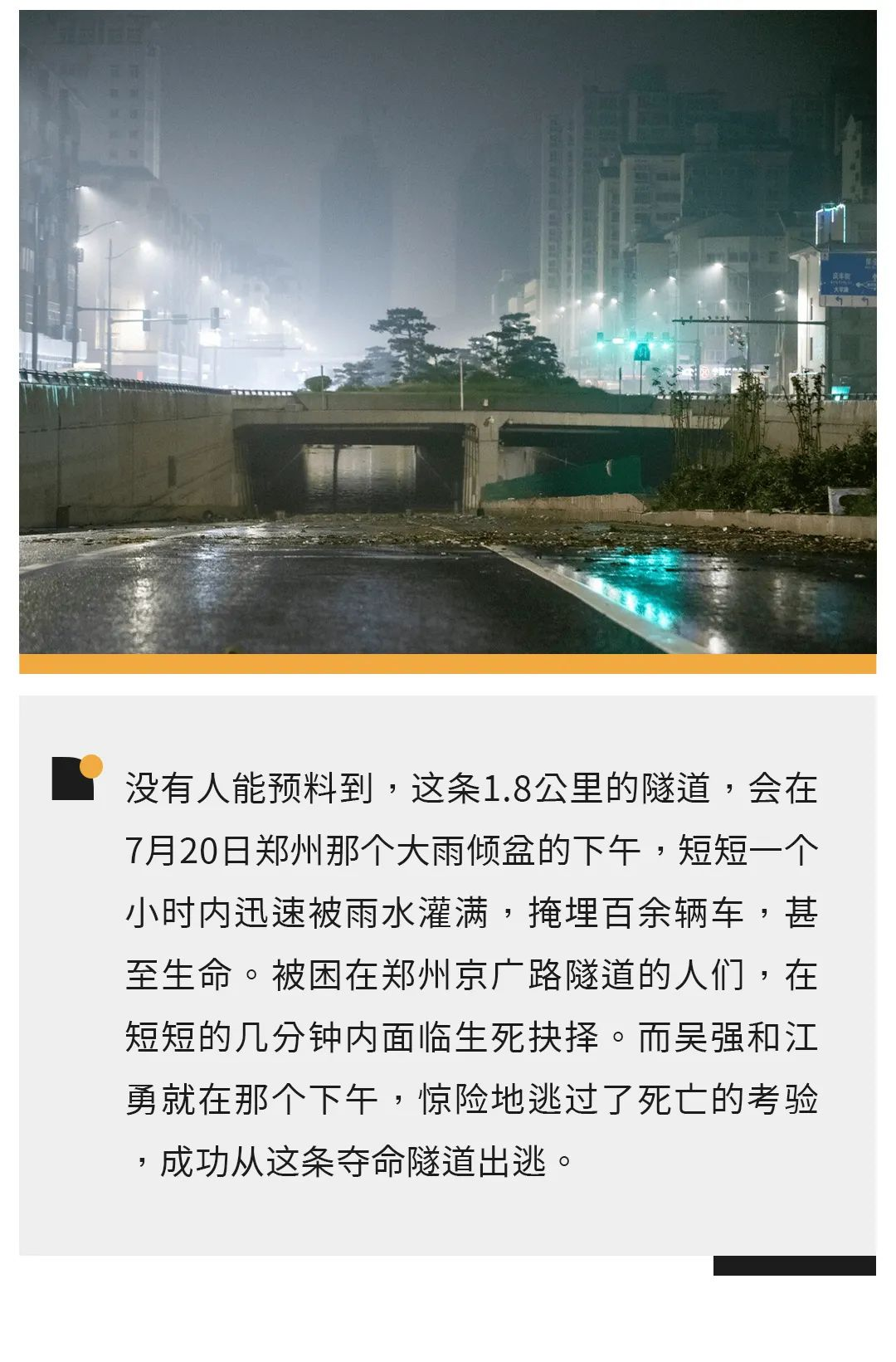
    京广路是纵贯这座城市南北的交通大动脉,上面有高架桥,下面是南北双向隧道。其中的京广北路隧道,全长1.8公里,距离郑州火车站西广场只有300米,是很多人通勤、旅行的必经之路。河南周口人江勇来郑州办事,这天下午,他开着黑色哈佛SUV,和吴强一样,也驶入了这条隧道。

    郑州市气象服务中心已经发布了四轮红色暴雨预警,但外面铺天盖地的大雨还没影响这个隔绝的地下通道。江勇在路边没有看到任何封路或禁止通行的标志,车辆如常地驶入,但他还是下意识点了一下刹车,担心隧道里万一有积水,会损坏车子。他很爱惜这辆车,买了快5年,已经把它当家庭成员,称呼它"小二"。

    此时大概下午三四点,地面潮湿,车辆行驶平稳,吴强和江勇一路向南,分别堵在隧道不同段的出闸处。有人说,前面路段积水较深,车过不去了。

    窗外是持续的大雨。江勇给妻子打电话,从妻子口中得知,郑州的这次暴雨有些不同寻常。他扭开车载广播,调到郑州交通广播电台,主持人只是提醒市民非必要不外出,随后如常播放广告。

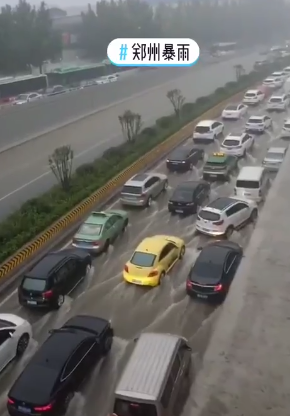
    车堵了将近一个小时,也没见有人来疏散。雨越下越大,地面的积水顺着陇海路倒流回隧道南出口的方向,迅速积累上升。浑浊的积水逐渐没到车子底盘,水流冲击车辆,带出令人牙酸的嘎吱嘎吱响声。江勇拉着手刹,心里有点害怕,觉得手刹已经有点不管用了,一直用脚踩着刹车。几个有经验的司机开始组织大家在车道上挤一挤,让后面的车辆都往前靠一靠,尽量远离地势低的地方。

    距离南出口上坡的几十米处,吴强的小车被雨水冲得被迫调头,他们试图控制车辆,开了没多远,车就熄火了。车里的三个男人慌了,开始轮番给110和119打电话,手机信号微弱,有时是占线,电话始终没有接通。

    直到后来脱险,吴强才在新闻中得知,他生活了二十多年的这座城市,此刻因为暴雨,正在面临众多生死考验。断电、断水,人们被困在地铁上、公司、家,街道交通被阻断。他对这一切毫无准备,生活在郑州这样的水资源并不丰富的中原地区,甚至他买了全险的车,唯独没有买涉水险。

    ● 7月22日,京广路陇海路交汇处大面积积水仍未退去。

    这时是下午5点左右,地面水流开始发出哗哗地,如河流涌过的声音。吴强的南向,江勇已经驶过陇海高架,到了另一段京广北路隧道,他同样被堵住,察觉到不对劲,跟副驾驶上的同伴说,"我下去看一下到底什么情况。"

    一下车,水已经没到江勇的膝盖位置。他往隧道出口方向瞟了一眼,"我后面那个车就已经起来了,被(水)漂起来了。"他当即做出决定,让同伴下车,两人弃车逃生。

    水流十分急促。江勇说,他大约150斤重,但当时已经被水流冲击得有点站不住了。他和同伴手挽着手,互相搀扶着往道路中间的绿化带转移。

    接下来的事情几乎发生在一瞬间。江勇走到绿化带大约花了2、3分钟,车子已经被冲跑了,"我有种冲动想上去把它开出来去救它,但是看看四周还是放弃了。"

    耳朵突然捕捉到一个致命的信号------"水流的声音一直就是哗哗哗,然后瞬间没有声音了,很安静,这个时候我才知道水满了,赶快撤。"江勇后来回忆只记得自己扯着嗓子喊,"拼命地喊前面的人赶快往上走。很快,大概就是在5分钟之内,隧道就灌满了。"

    江勇最后回头看了一眼隧道,"已经是汪洋一片。"京广北路隧道几个红色大字都被淹了一小半。他看到一位男士,应该是刚从车里逃生,正努力地游着泳往隧道外划。

    ● 两天后,江勇回到现场找到了他的黑色"小二"。讲述者供图

    江勇获救的时候,浑浊的水流正冲击着吴强的小车,水位上涨得很快,车不受控地漂起来了,沿着隧道的方向退回两百多米。隧道里的灯灭了,陷入一片漆黑,隧道外是铺天盖地的暴雨,天地一片迷蒙,浇得人眼前什么都看不清,信号时断时续,向外求助没有得到任何回应。

    吴强的记忆里,此时隧道里的水已经涨到了一米六七的高度,封闭的汽车车厢也开始渗水。那一刻,吴强心里冒出一个恐怖的念头------死亡到跟前了。他脑子里一片空白,唯一盘旋的想法是,"我孩子那么小,才六岁,还没上一年级呢,他怎么办呢?"

    一定要坚持,车里的三个男人互相鼓励着。只能留一个算一个,他们决定自救。打开了唯一通往外界的天窗,会游泳的弟弟首先爬到车顶,试图先游出去。倒灌的逆流又急又多,拍得人无法前进,他被水堵住了,只能先游到一侧紧紧扒住东边的桥架上的一根电缆线。

    吴强原本也准备游出去,但这样五十多岁不会游泳的司机就成为了那个落单的人,他执意要和司机一起,他们一起工作7年了。"你先走",司机催促他。"你一个人在里面咋弄?我陪你",吴强不肯,最后两个人一起爬到车顶。

    十分钟,倒灌进隧道的水已经迅速涨到了人脖子的高度,前后的面包车和小轿车沉下去了,却始终不见人出来。爬到车顶的吴强,眼前除了两三辆漂在水面上的车,逐渐被水流带着从南往北漂,其他什么都看不见了。司机蹲在车顶,他蹲在引擎盖上,抓住挡风玻璃上的雨刮器。奥迪A8像一座小小的孤岛,在浑浊的水中,一会儿漂到东边,一会儿漂到西边,摇摇欲坠。

    水在上涨,车在渗水下沉,离开车顶就是死路一条。他们只有一个机会------等待车漂到靠近桥架的时候,迅速攀到桥架一侧,沿着爬出去,或者等待救援。

    吴强正在迎接最后的决战------抽掉腰间的皮带,准备脱掉累赘的裤子,万一掉到水里,游起来更方便。还没来得及脱裤子,这两个四五十岁的中年男人就抓住了珍贵的机会,攀到东侧的桥架,等他们扒稳,脚下的奥迪A8似乎完成了它的使命,载着遗留的项目材料沉入水底。

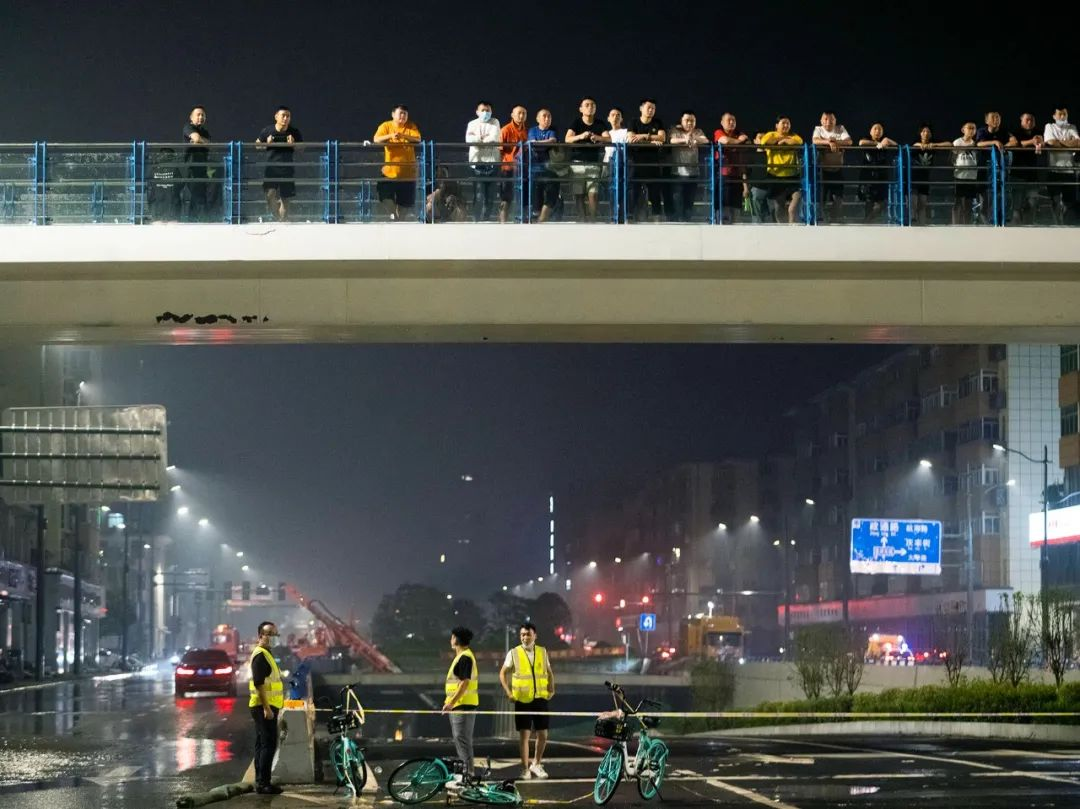
    "已经顾不上(车辆)损失什么的了,当时就想,活着吧。"巨大的消耗让三个人精疲力竭,吴强拿着手机继续报警,弟弟拼命地呼喊"救命",望上去高架的周边围着一些打雨伞、穿雨衣的陌生人,隔着巨大的雨幕,看不清他们的神情,只有手机对着三个孤零零的身影在拍视频。

    ● 7月23日凌晨,天桥上的围观者。图/吕萌

    报警电话终于通了,吴强描述了一下大致的位置,"赶紧救命,我们有三条人命",一个对话来回的时间,水压迫到吴强的脖子处,他喘不上气来,等待救援人员明显已经来不及了。虽然距离隧道口只有五米远,他一点体力也没有了,四肢失去知觉,全靠本能扒住桥架。这个当过兵、从江苏来郑州打拼了二十多年的中年人精疲力竭,迎来了一天中最绝望的时刻。

    只能指望自己了。弟弟首先顺着上涨的水游到平台上,还呛了几口水,然后伸手拉不会游泳的司机,吴强在下方托着他翻上去,手机不小心掉进了水里;再靠岸上的两个人趴着地面,把吴强硬拉上去。此刻,隧道里已经看不到其他人了,不到三分钟,三个惊魂未定的人眼睁睁看着整个隧道被雨水完全灌满。

    事后,据财新报道,负责救援的工作人员介绍,京广北路隧道内积水最深处达13米左右。

    "我大概是最后一个逃离的",吴强看着被吞没的隧道口,有些庆幸捡回一条命。他们被收容在离隧道不远的一栋小楼的五层,那是一个无眠的夜晚,吴强一直坐着发呆。凌晨三点他似乎还听到窗外有人在喊救命,从窗户外看下去,停在马路中间的丰田普拉多,将近两米高的车看不到车顶,只有铲车在雨里忙着找人救人。

    那时江勇和同伴在一处几乎没什么积水的酒店里。这是他在高架上走了几个小时,能找到的最好的地方。当晚,酒店到处是避难的人,房间早满人了,连走廊、楼梯口都是疲倦又惊恐未定的人群。江勇和同伴缩在一楼的楼梯上,将就过了一晚,但一直没合眼,时刻担心着水流又再哗哗地涌上来。

    第二天早上,吴强光着脚、披着当雨衣的塑料桌布,蹚水走了三四公里回家,才在备用手机上看到各地的战友们问候的消息,回过神来的吴强觉得有些荒谬,"很丢人,我在郑州这么一个缺水的城市,在大街上差点被淹死,是不是一件可笑的事情?"

    城市里的积水逐渐退去,吴强浑身疼,弟弟喝了脏水上吐下泻的,在医院输液,只有司机隔了两天回到隧道查看了一下,隧道里的水大概还有五六米深,救援队在忙碌着,黑色奥迪A8依旧不见踪影。

    ● 吴强的奥迪车依然不见踪影。讲述者供图

    7月22日,随着十多台泵机投入抽水和清淤作业,两天前那个下午逐渐浮出水面,车辆的残骸混着泥堆叠在一起,残留在车里的遗体被发现,周围有车主和家属等待着。江勇找到了"小二",它头朝下挂在隧道南出口,已经全毁了,到处是泥渍和湿漉漉的水痕。他钻进车里取回了驾驶证等物品,看着"小二"有点伤感,"毕竟车子是男人的第二个家。"

    江勇开始忧心接下来的生活。而一位母亲还在寻找着当天骑着电动车,在隧道中失联的两个男孩。市民拥在隧道两边,有路过的人听到了哭声。

    ● 漂浮在积水上的童鞋。图/吕萌

  13. thphd   回复文章

    对从品葱跑到2047的一些感想

    @沉默的火安静地烧 #149439

    不友善用户和三色名单颇有指定住所监视居住的风味,这种不知道定啥罪就整人整出罪的行为,让本人大脑里的支性雷达一直吱吱作响

    指定住所监视居住,是中国《刑事诉讼法》中存在的条文,但品葱《习惯法》并没有不友善、三色相关的条文。

    但是管理员操作指南第1条还是“新品葱采用习惯法治理”,所以无论多了多少个专政小工具,也妨碍不了(我个人)表面法治的判断,就好像我认为中国也有表面法治一样啊

    如果操作指南有【法】字就叫【表面法治】,那本站的公安备案字样大概也可以算是【表面钓鱼】了。

    在论坛这种实质专政setting下,法的实际效果主要取决于执行者的素质。https://2047.name/t/7771

  14. 政治局局长   回复文章

    未来的美国宪法建议稿

    总统任期四年,由年满十六周岁的美利坚合众国公民以普遍、自由、直接、无记名、平等和一人一票的方式选举产生。 总统选举应当在四的整倍数公历年份十一月的第一个星期六举行。总统任期自下一年的一月二十日零时开始,以总统办公地点的时区为准。 总统选举投票时,没有候选人得到超过半数有效选票的,应当在第一轮选举后二十八日,对得票最多的两名候选人进行第二次投票,得票较多的候选人当选。第一轮投票得票第二多的候选人有数人,或者第二轮两名候选人得票相等时,由众议院决定人选。

    为什么十六岁就能投票?我觉得投票年龄十八岁就够了。

    为什么总统选举日要规定死?假设那一天发生地震,难道人民也要去投票吗?

    全国直选总统是几乎不可能出现两党候选人票数一样的情况吧。过亿人投票不可能做到两位候选人得票数量完全相同。

    全民投票一次很花钱的,所以我建议改成排序复选制,这样就需要举办一次全国性投票即可。

  15. 能井 元悪魔候補生
    能井   发表文章

    今日因特网某角落辩经言论一览,单纯乐一下。

    内容已删除
    内容已被作者本人或管理员删除。 如有疑问,请点击菜单按钮,查看管理日志以了解原因。
  16. 沉默的火安静地烧   回复文章

    对从品葱跑到2047的一些感想

    @thphd #149424 管理员内部是另一套逻辑,类同共党内部实行党法(笑

    不友善用户和三色名单颇有指定住所监视居住的风味,这种不知道定啥罪就整人整出罪的行为,让本人大脑里的支性雷达一直吱吱作响

    但是管理员操作指南第1条还是“新品葱采用习惯法治理”,所以无论多了多少个专政小工具,也妨碍不了(我个人)表面法治的判断,就好像我认为中国也有表面法治一样啊

    毕竟对于大多数用户而言不用这些小工具,习惯法就够了

    你个老葱迷还反问这些答案明显的问题是干嘛啊,我要不是看到krd在r/chonglangTV大庭广众之下喊自己是真·正统王道加速人,都不知道他被葱赶跑了。我都没你葱迷,瑞贝卡啊瑞贝卡,你才是真·葱迷

    继续摸鱼去玩今天的google doodle了,刷个全奖杯

  17. 政治局局长   回复文章

    未来的美国宪法建议稿

    我感觉这套宪法类似于韩国的制度,比现在的制度更好,我支持。

  18. thphd   回复文章

    【调查】2021河南水灾实际死亡数字

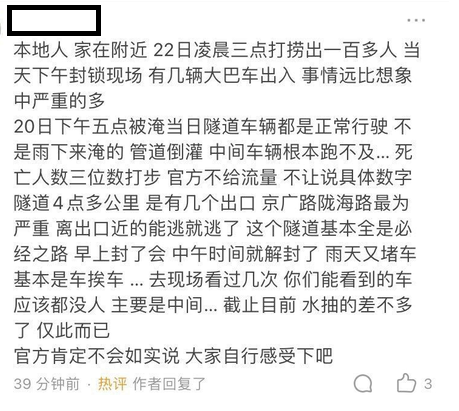
    基本可以确定隧道死1000人以上。

    https://twitter.com/fangshimin/status/1418408040764637184?s=20

    澎湃新闻发了“上千车辆浸没”的京广路隧道现场视频,已删除,只在香港新浪网还有痕迹。被网友拍到抬出两具尸体的视频后,官方承认隧道里死亡两人。大批警察已往隧道周围戒严,禁止围观、拍摄,为了“郑州形象”。

  19. jiucaizi   回复文章

    谈革命[10] (已定稿): 如何开展非暴力革命

    @libgen #149218 很有启发,俺已按照你的评论更新了文档,欢迎继续点评。

    不过俺认为加密货币、代币等激励方式,还不足以支撑产业。或许互联网目前就还没有一套好的方案。社交网络产业化的重点还是娱乐、出卖用户数据的套路。substack的模式算是非匿名网络的一种尝试,效果如何还有待观望,毕竟用户付费与广告模式难说谁更好。目前俺能想到的匿名社区的激励还是情怀和爆料时规避风险为主。

  20. 爱狗却养猫 饭丝
    爱狗却养猫   回复文章

    🍵茶餐廳🍵

    @消极 #149429 堂堂消老师,怎么像爱拉小女孩辫子的小男生那么纯情?

    The story begins in a bridge club named "Griffins Club".

    消老师,求解。

  21. 邹韬奋 外逃贪官CA
    邹韬奋   回复文章

    【國安法第一案手記】“时代革命”含有港独的意思吗?

    @thphd #149432 “大家看好了,站长公然支持港独,大家有什么砖头都往他身上招呼,特别是皇汉们还有九头鸟同志,赶快砸死站长”

  22. jiucaizi   回复文章

    投票:匿名论坛理论上很容易发生ID冒用,为什么这种行为实际很少发生?

    俺也比较倾向于人性论,前面已经有人提到过了

    人的本能不愿冒用别人ID

    大部分人的心理结构是以自我为中心的,生活在自己的故事线里,因此注册时最自然反应是用自己最常用的ID。要想起一个普通路人的ID并不容易,但名人的名字被媒体反复提及,已经被刻入每个人自己的故事线里,因此常被作为ID使用,这也说明ID选择能透露普通人的偏好。

  23. thphd   回复文章

    【國安法第一案手記】“时代革命”含有港独的意思吗?

    @公孙策2 #149310

    综上所述,从字面理解的“光复香港”不是港独,而是英统派,主张香港重新成为大英帝国的一部分。

    控辩双方均已表示“不能从字面理解”,您何苦再“从字面理解”呢


    @猫宅冻 #149392

    这一整个口号确实有不同的解读方向。但单凭一个口号要定分裂国家的罪,实在是过于牵强。但欲加之罪何患无辞呢。

    首先,强烈推荐大家看 /t/13553/t/13586

    作为持大陆护照的围观看客,本来就没必要纠结这个口号代表什么意思——即便它代表港独又怎么样?倘若独立能得到自由,那但凡有脑子都会选独立,傻子才会选减少自由的选项。所以问题的关键在于,香港人如果独立、脱离共产党管制,能否获得更多自由?

    然后我们再看这个庭审。控方指控的,实际上就是中国大陆的“寻衅滋事罪”+“煽动颠覆国家政权罪”。

    这种涉及政治的罪名,按照大陆的惯例(参考本站“端点星案”),会先关押审讯一到两年,不让见自己律师,由当局强制指派“法律援助律师”(变相剥夺律师权利)是家常便饭,保释也保不出来,庭审也不可能公开,不会允许记者旁听,庭审记录也不会允许在媒体上发表,判决书也要从裁判文书网上删除。基本上就是黑箱操作。

    结果在香港,同一个罪名,不仅公开庭审,还请了多名大学教授,认认真真一字一句去分析,你的口号到底是不是煽动颠覆,对控方的论点逐一反驳,法官全都是专业人士,认真倾听双方的解释,整个过程在媒体上完全公开。

    所以这个庭审,不管结果如何,都说明一个事实,那就是在香港,就算你触犯国安法,涉嫌煽动分裂国家,被警察抓起来,你都比在大陆自由(有充分的时间和机会为自己辩解)。这种建立在对每个人合法权利的尊重之上的自由,是值得我们每一个人追求的。如果独立能让香港保留这种自由,那我支持香港独立,你们可以打我了。

  24. 邹韬奋 外逃贪官CA
    邹韬奋   回复文章

    对从品葱跑到2047的一些感想

    @thphd #149424 站长明断!

    @爱狗却养猫 #149416 所以论坛不是国家,不是政府,而是一个俱乐部。俱乐部的宗旨不是什么明辨是非,而是宾至如归。

    The story begins in a bridge club named "Griffins Club".

  25. 邹韬奋 外逃贪官CA
    邹韬奋   回复文章

    🍵茶餐廳🍵

    @消极 #148025 为什么过了这么久,还是只有瑶瑶一个是女的?

  26. 邹韬奋 外逃贪官CA
    邹韬奋   回复文章

    🍵茶餐廳🍵

  27. 邹韬奋 外逃贪官CA
  28. 邹韬奋 外逃贪官CA
    邹韬奋   回复文章

    历史性时刻:计划生育基本上宣告终结

    @蜜瓜铁树 #149422 第一,当时一般人上不了互联网,对维稳没有威胁;第二,上网对经济有贡献,而且后来证明是巨大的贡献。有利无弊为何不搞?

    @爱狗却养猫 #149417 很多半民主国家都有类似的审查机构,但是只有在中国,审查被视为生死存亡的大事。

  29. 爱狗却养猫 饭丝
    爱狗却养猫   回复文章

    历史性时刻:计划生育基本上宣告终结

    @蜜瓜铁树 #149422 具体的过程我并不清楚,以下只是推测。

    中国互联网开始发展的时候正好是中国的经济开放期与美国对中国执行“接触政策”的时期,当时互联网作为一种国外引进的、只有少数人能使用新生事物,性质与个人电脑、影碟机或其他高科技gadgets并没有很大不同。

    而中共开始对互联网的控制问题产生重视的时候,中国的网民已有相当规模,同时网络作为经济增长点的前景逐渐显现。所以大概在经济利益和舆论控制之间,中共希望兼得,并且认为可以兼得。

    edit: 我突然有个想法,或许建GFW而非朝鲜式禁网,正是因为蛤比较有文化水平。如果换了总加速师,说不定真的就一刀切禁网了。

    edit again: 当时回复的时候没注意主贴,抱歉离题了……如果要就此讨论再开贴或者转茶餐厅吧。

  30. 邹韬奋 外逃贪官CA
  31. thphd   回复文章

    对从品葱跑到2047的一些感想

    @沉默的火安静地烧 #149382

    无论如何,逃避不了的是【习惯法条文】。即使是站长,也需要用“某人临时小号”去引用习惯法来给予处罚。这就是品葱一直维持着的表面法治

    “表面法治”?excuse me?

    krd不骂人就不能正常生活,每天坚持违反习惯法,一直被其他管理员(包括一只鹿儿、荣誉非国民)依法处罚,然后一直被站长解除处罚,是为什么呢?

    品葱习惯法没有不友善用户的定义,品葱站长到处把他不喜欢的用户标记为不友善用户, 是为什么呢?

    同理,黑白灰名单是为什么呢?不许用户自己加头衔,却给用户乱加头衔,删也删不掉,是为什么呢?

  32. 露易莎   回复文章

    未来的美国宪法建议稿

    TITLE 4 Judiciary PARTE 4 Judicatura 第四章 司法

    Article 87 Artículo 87º 第八十七条

    1. Cases in the courts of the United States and states shall be heard by judges.

    2. The law enacted by the state legislature may provide for the participation of persons other than judges in hearing cases in the state courts. However, any part of the court decision shall be approved by at least half of the judges involved in the trial.

    3. Los jueces conocerán los casos en los tribunales de los Estados Unidos y los estados.

    4. La ley promulgada por la legislatura estatal puede estipular la participación de personas que no sean jueces en la audiencia de casos en los tribunales estatales. Sin embargo, cualquier parte de la decisión judicial deberá ser aprobada por al menos la mitad de los jueces involucrados en el juicio.

    美利坚合众国和各州法院的案件,均由法官审理。 州议会制定的法律可以规定,法官以外的其他人参与审理本州法院的案件。但法院裁判的任何部分,至少须经过参与审理案件的过半数法官同意。

    Article 88 Artículo 88º 第八十八条

    1. Judges shall exercise their powers independently without interference from others.

    2. Cases in the courts shall be randomly allocated to judges based on the general provisions of the law.

    3. The provisions of this article apply to other persons involved in the trial of state court cases.

    4. Los jueces ejercerán sus poderes de forma independiente sin injerencia de otros.

    5. Los casos en los tribunales se asignarán aleatoriamente a los jueces de acuerdo con las disposiciones generales de la ley.

    6. Las disposiciones de este artículo se aplican a otras personas involucradas en el juicio de casos en tribunales estatales.

    法官独立行使职权,不受他人干涉。 法院的案件,应当以法律的一般性规定为依据,随机配给法官。 参与审理州法院案件的其他人,适用本条规定。

    Article 89 Artículo 89º 第八十九条

    Judges may not concurrently hold other public positions, nor may they hold management positions in any social organization, political party, enterprise, or other institution, except for social organizations established specifically to protect the interests of judges.

    Los jueces no podrán ocupar simultáneamente otros cargos públicos, ni podrán ocupar cargos gerenciales en ninguna organización social, partido político, empresa u otra institución, excepto las organizaciones sociales establecidas específicamente para proteger los intereses de los jueces.

    法官不得兼任其他公职,也不得担任任何社会团体、政党、企业或其他机构的管理职务,但专为维护法官利益而成立的社会团体除外。

    Article 90 Artículo 90º 第九十条

    The United States shall have one Federal Supreme Court and one Federal Court of Appeals.

    Los Estados Unidos tendrán una Corte Suprema Federal y una Corte Federal de Apelaciones.

    美利坚合众国设一个联邦最高法院和一个联邦上诉法院。

    Article 91 Artículo 91º 第九十一条

    If this Constitution does not provide that the Federal Supreme Court or the Federal Court of Appeals shall exercise the jurisdiction of the first instance, the state courts shall exercise the jurisdiction of the first instance.

    Si esta Constitución no dispone que el Tribunal Supremo Federal o el Tribunal Federal de Apelaciones ejerzan la jurisdicción de primera instancia, los tribunales estatales ejercerán la jurisdicción de primera instancia.

    本宪法未规定由联邦最高法院或联邦上诉法院行使初审管辖权的,由州法院行使初审管辖权。

    Article 92 Artículo 92º 第九十二条

    1. The Federal Supreme Court consists of nine judges who serve a term of twelve years and may not be reappointed consecutively or inconsecutively. Among them, the terms of the three judges shall start at 00:00 on January 1st of the Gregorian calendar year that is an integer multiple of twelve, the terms of three judges shall start at 00:00 on January 1st of the Gregorian year that is an integer multiple of twelve and four, and the terms of three judges shall start at 00:00 on January 1st of the Gregorian year that is an integer multiple of twelve and eight. The above time shall be based on the time zone of the office of the Federal Supreme Court.

    2. Of the three judges serving the same term, two shall be elected by the House of Representatives with a two-thirds majority, and one shall be elected by the Senate with a two-thirds majority.

    3. In the vacance of a judge, by-elections shall be made by the House of Representatives or Senate that originally elected the judge. The by-election judges shall serve until the expiry date of the original term.

    4. El Tribunal Supremo Federal está integrado por nueve jueces que cumplen un mandato de doce años y no pueden ser reelegidos de forma consecutiva o inconsecuente. Entre ellos, los términos de los tres jueces comenzarán a las 00:00 horas del 1 de enero del año calendario gregoriano que es un múltiplo entero de doce, los términos de los tres jueces comenzarán a las 00:00 horas del 1 de enero del año gregoriano que es un múltiplo entero de doce y cuatro, y los términos de tres jueces comenzarán a las 00:00 del 1 de enero del año gregoriano que es un múltiplo entero de doce y ocho. El tiempo anterior se basará en la zona horaria de la oficina de la Corte Suprema Federal.

    5. De los tres jueces que sirven el mismo período, dos serán elegidos por la Cámara de Representantes con una mayoría de dos tercios y uno será elegido por el Senado con una mayoría de dos tercios.

    6. En la vacante de un juez, las elecciones parciales serán realizadas por la Cámara de Representantes o el Senado que originalmente eligió al juez. Los jueces de elección parcial servirán hasta la fecha de vencimiento del mandato original.

    联邦最高法院由九名法官组成,任期十二年,不得连任或再任。其中,三名法官的任期自十二的整数倍的公历年的一月一日零时开始,三名法官的任期自十二的整数倍加四的公历年的一月一日零时开始,三名法官的任期自十二的整数倍加八的公历年的一月一日零时开始。以上时刻以联邦最高法院办公地点的时区为准。 同任期的三名法官中,二名由众议院以三分之二多数选举产生,一名由参议院以三分之二多数选举产生。 法官缺位时,由原选举法官的众议院或参议院补选。补选的法官任期至原任期届满之日。

    Article 93 Artículo 93º 第九十三条

    The Federal Supreme Court has first-instance jurisdiction over the following cases and the case shall be heard by plenum: (1) disputes between the president, cabinet, members of the cabinet, the two houses of Congress or members of Congress of the United States, between the United States and the state, and between the states and states, over the matters stipulated in this Constitution; (2) disputes over whether laws enacted by the Congress directly infringe the human rights stipulated in this Constitution; (3) disputes over the results of the election of the President or the Congress; (4) disputes submitted by the president, the cabinet, a member of the cabinet, either house of Congress, a member of Congress, or each state over whether a law or budget passed by the Congress violates this Constitution.

    El Tribunal Supremo Federal tiene jurisdicción de primera instancia sobre los siguientes casos y el caso se conocerá en pleno: (1) disputas entre el presidente, gabinete, miembros del gabinete, las dos cámaras del Congreso o miembros del Congreso de los Estados Unidos, entre los Estados Unidos y el estado, y entre los estados y estados, sobre la materias estipuladas en esta Constitución; (2) disputas sobre si las leyes promulgadas por el Congreso violan directamente los derechos humanos estipulados en esta Constitución; (3) disputas sobre los resultados de la elección del Presidente o del Congreso; (4) disputas presentadas por el presidente, el gabinete, un miembro del gabinete, la cámara del Congreso, un miembro del Congreso o cada estado sobre si una ley o presupuesto aprobado por el Congreso viola esta Constitución.

    联邦最高法院对下列案件享有初审管辖权,该案件由全体法官审理: (一)美利坚合众国的总统、内阁、内阁成员、国会两院或国会议员之间、美利坚合众国与州之间、州与州之间,对本宪法规定的事项的争议; (二)对国会制定的法律是否直接侵害本宪法规定的人权的争议; (三)对总统或国会选举结果的争议; (四)总统、内阁、内阁成员、国会两院、国会议员或各州对国会通过的法律案或预算案是否违反本宪法的争议。

    Article 94 Artículo 94º 第九十四条

    The decision of the Federal Court of Appeals may be appealed to the Federal Supreme Court in any of the following circumstances: (1) it is necessary to review whether state laws or federal laws violate this Constitution; (2) it is necessary to review whether state laws or federal laws violate international treaties; (3) it is necessary to review whether the Congress violates its legislative obligations; (4) involving the interpretation of this Constitution.

    La decisión de la Corte Federal de Apelaciones se puede apelar ante la Corte Suprema Federal en cualquiera de las siguientes circunstancias: (1) es necesario revisar si las leyes estatales o las leyes federales violan esta Constitución; (2) es necesario revisar si las leyes estatales o las leyes federales violan los tratados internacionales; (3) es necesario revisar si el Congreso viola sus obligaciones legislativas; (4) involucrar la interpretación de esta Constitución.

    联邦上诉法院的裁判,有下列情形之一时,可以向联邦最高法院上诉: (一)需要审查州法律或联邦法律是否违反本宪法的; (二)需要审查州法律或联邦法律是否违反国际条约的; (三)需要审查国会是否违反立法义务的; (四)涉及本宪法的解释的。

    Article 95 Artículo 95º 第九十五条

    1. After the Federal Supreme Court receives the appeal petition, one judge shall review whether the original judgment made an error in the judgment of the matters stipulated in Article 94. If he or she believes that there is an error, the case shall be submitted to the plenum for trial. If he or she believes that there is no error, the case shall not be accepted.

    2. When the plenum of the Federal Supreme Court hears a case, the decision shall obtain the consent of the five judges.

    3. Luego de que la Corte Suprema Federal reciba la petición de apelación, un juez revisará si la sentencia original cometió un error en el juicio de los asuntos estipulados en el Artículo 94º. Si cree que hay un error, el caso será sometido. al pleno para juicio. Si cree que no hay error, no se admitirá el caso.

    4. Cuando el pleno del Tribunal Supremo Federal conozca de un caso, la decisión deberá obtener el consentimiento de los cinco jueces.

    联邦最高法院收到上诉状后,应当由一名法官审查原裁判对第九十四条规定的事项的判断是否存在错误,如果认为存在错误,应当提交全体法官审理,如果认为不存在错误,应当不予受理。 联邦最高法院全体法官审理案件时,其裁判应当取得五名法官的同意。

    Article 96 Artículo 96º 第九十六条

    1. The number of judges in the Federal Court of Appeals shall be determined by a law enacted by the Congress.

    2. Judges of the Federal Court of Appeals serve life, and shall be nominated by the President and approved by a two-thirds majority of the Senate..

    3. The Chief Judge of the Federal Court of Appeals is elected by secret ballot by all the judges of the Federal Court of Appeals. He serves a term of one year and may not be re-elected consecutively or inconsecutively, except that all the judges of the Federal Court of Appeals have served as the Chief Judge.

    4. El número de jueces de la Corte Federal de Apelaciones será determinado por ley promulgada por el Congreso.

    5. Los jueces de la Corte Federal de Apelaciones son vitalicios y serán nominados por el Presidente y aprobados por una mayoría de dos tercios del Senado.

    6. El Juez Jefe del Tribunal Federal de Apelaciones es elegido en votación secreta por todos los jueces del Tribunal Federal de Apelaciones. Sirve por un período de un año y no puede ser reelegido consecutiva o inconsecuentemente, excepto que todos los jueces de la Corte Federal de Apelaciones hayan servido como Juez Principal.

    联邦上诉法院的法官人数,由国会制定的法律确定。 联邦上诉法院的法官任期终身,由总统提名,参议院三分之二多数批准。 联邦上诉法院的首席法官,由全体联邦上诉法院法官无记名投票产生,任期一年,不得连任或再任,但所有联邦上诉法院法官均已担任过首席法官的除外。

    Article 97 Artículo 97º 第九十七条

    The judgment of a state court may be appealed to the Federal Court of Appeals if it may not be appealed to a higher court in the state and one of the following circumstances exists: (1) one of the circumstances stipulated in Article 94 exists; (2) the courts of the states have differences in the interpretation of the federal law and there is a need for a unified interpretation; (3) in the case there is a dispute over the interpretation and application of federal laws, unless according to the law enacted by the Congress it is an unimportant case.

    El fallo de un tribunal estatal puede apelarse ante el Tribunal Federal de Apelaciones si no puede apelarse ante un tribunal superior en el estado y existe una de las siguientes circunstancias: (1) existe una de las circunstancias previstas en el Artículo 94º; (2) los tribunales de los estados tienen diferencias en la interpretación de la ley federal y existe la necesidad de una interpretación unificada; (3) en el caso de que exista una disputa sobre la interpretación y aplicación de las leyes federales, a menos que de acuerdo con la ley promulgada por el Congreso sea un caso sin importancia.

    州法院的裁判,在不能向该州更高级别的法院上诉的情况下,有下列情形之一时,可以向联邦上诉法院上诉: (一)存在第九十四条规定的情形的; (二)各州法院对联邦法律的解释存在分歧,有统一解释的必要的; (三)对联邦法律的解释和适用存在争议的,但根据国会制定的法律属于非重要案件的除外。

    Article 98 Artículo 98º 第九十八条

    The impeachment of judges of the Federal Supreme Court and the Federal Court of Appeals shall be subject to the provisions of Article 66.

    El juicio político de los jueces del Tribunal Supremo Federal y del Tribunal Federal de Apelaciones se sujetará a lo dispuesto en el Artículo 66º.

    联邦最高法院和联邦上诉法院法官的弹劾,适用第六十六条的规定。

    TITLE 5 Federal System PARTE 5 Sistema federal 第五章 联邦制度

    Article 99 Artículo 99º 第九十九条

    1. The United States is based on the principles of democracy, the rule of law, human rights and federalism.

    2. The organization of each state is regulated by the state constitution.

    3. The state constitution shall not violate this constitution and federal laws, and shall conform to the principles of democracy, the rule of law, and human rights.

    4. Los Estados Unidos se basan en los principios de la democracia, el estado de derecho, los derechos humanos y el federalismo.

    5. La organización de cada estado está regulada por la constitución estatal.

    6. La constitución estatal no violará esta constitución ni las leyes federales y se ajustará a los principios de la democracia, el estado de derecho y los derechos humanos.

    美利坚合众国以民主、法治、人权和联邦制为原则。 各州的组织由州宪法规定。 州宪法不得违反本宪法和联邦法律,并须符合民主、法治、人权原则。

    Article 100 Artículo 100º 第一百条

    Territories actually controlled by the United States that have no residents and do not belong to any state shall be governed by laws established by the Congress.

    Los territorios efectivamente controlados por los Estados Unidos que no tienen residentes y no pertenecen a ningún estado se regirán por las leyes establecidas por el Congreso.

    美利坚合众国实际控制的领土,没有居民且不属于任何一个州的,根据国会制定的法律管理。

    Article 101 Artículo 101º 第一百〇一条

    1. The official languages of the United States are English, Spanish and Chinese.

    2. The official languages of the United States are also the official languages of each state, without prejudice to each state’s decision on other official languages.

    3. Official notices or documents of the United States to the public shall be issued in English, Spanish and Chinese at the same time, and the contents of these three languages shall have the same effect.

    4. Los idiomas oficiales de Estados Unidos son inglés, español y chino.

    5. Los idiomas oficiales de los Estados Unidos son también los idiomas oficiales de cada estado, sin perjuicio de la decisión de cada estado sobre otros idiomas oficiales.

    6. Los avisos o documentos oficiales de los Estados Unidos al público se emitirán en inglés, español y chino al mismo tiempo, y el contenido de estos tres idiomas tendrá el mismo efecto.

    美利坚合众国的官方语言为英语、西班牙语和汉语。 美利坚合众国的官方语言同时为各州的官方语言,但不妨碍各州自行规定其他官方语言。 美利坚合众国对公众发布的官方通知或文件,应当同时使用英语、西班牙语和汉语,三种语言的内容具有同等效力。

    Article 102 Artículo 102º 第一百〇二条

    A state's application to join or withdraw from the United States shall be approved by a two-thirds majority of each house of Congress.

    La solicitud de un estado para unirse o retirarse de los Estados Unidos deberá ser aprobada por una mayoría de dos tercios de cada cámara del Congreso.

    州申请加入或退出美利坚合众国,须经国会两院分别以三分之二多数通过。

    Article 103 Artículo 103º 第一百〇三条

    In the relationship between the United States and the states and between the states, the parties shall assist each other and handle their relations in accordance with the principle of good faith.

    En la relación entre los Estados Unidos y los estados y entre los estados, las partes se asistirán mutuamente y manejarán sus relaciones de acuerdo con el principio de buena fe.

    在美利坚合众国和各州以及各州之间的关系上,各方应当相互协助,并按照诚实信用原则处理彼此的关系。

    Article 104 Artículo 104º 第一百〇四条

    In order to ensure that the states have the appropriate fiscal capacity, Congress shall enact laws that, based on the economic indicators of the states, provide for the federal payment of subsidies to the states and the mutual payment of subsidies between the states.

    Para asegurar que los estados cuenten con la capacidad fiscal adecuada, el Congreso promulgará leyes que, con base en los indicadores económicos de los estados, prevean el pago federal de subsidios a los estados y el pago mutuo de subsidios entre los estados.

    为确保各州具有适当的财政能力,国会应当制定法律,以各州经济指标为依据,规定联邦对各州支付补助,以及各州相互支付补助。

    Article 105 Artículo 105º 第一百〇五条

    The United States and the states shall mutually recognize the legal decisions of each other’s public authorities.

    Los Estados Unidos y los estados reconocerán mutuamente las decisiones legales de las autoridades públicas de cada uno.

    美利坚合众国和各州相互承认对方公共机关的合法决定。

    Article 106 Artículo 106º 第一百〇六条

    1. In the event of war, natural disasters, or other emergencies, the state may request the United States to exercise its power on its behalf.

    2. In the event of the event specified in the preceding paragraph and the state is unable to exercise its power, Congress may also decide that the United States shall act on the state's power.

    3. En caso de guerra, desastres naturales u otras emergencias, el estado puede solicitar a los Estados Unidos que ejerzan su poder en su nombre.

    4. En el caso de que ocurra el evento especificado en el párrafo anterior y el estado no pueda ejercer su poder, el Congreso también podrá decidir que los Estados Unidos actuarán en el poder del estado.

    发生战争、自然灾害或其他紧急事件时,州可以请求美利坚合众国代行其权力。 发生前款规定的事件,且州没有能力行使权力,国会也可以决议,由美利坚合众国代行州的权力。

    TITLE 6 Constitution Amendment PARTE 6 Enmienda constitucional 第六章 宪法修改

    Article 107 Artículo 107º 第一百〇七条

    1. Amendments to this Constitution shall be approved by the two houses of Congress by a two-thirds majority respectively, and then submitted to the President for promulgation by the Senate.

    2. Amendments to this Constitution shall be revised in the original text of this Constitution, and amendments shall not be listed separately.

    3. The core content of democracy, rule of law, human rights and federalism may not be amended.

    4. The amendment of this Constitution applies the provisions of Article 50, but the President has no power of veto.

    5. Las enmiendas a esta Constitución serán aprobadas por las dos cámaras del Congreso por mayoría de dos tercios, respectivamente, y luego presentadas al Presidente para su promulgación por el Senado.

    6. Las enmiendas a esta Constitución se revisarán en el texto original de esta Constitución, y las enmiendas no se enumerarán por separado.

    7. El contenido fundamental de la democracia, el estado de derecho, los derechos humanos y el federalismo no podrá modificarse.

    8. La reforma de esta Constitución aplica las disposiciones del Artículo 50º, pero el Presidente no tiene poder de veto.

    本宪法的修改,须经国会两院分别以三分之二多数通过,并由参议院提交总统公布。 本宪法的修改,须在本宪法原文上修改,不得单列修正案。 民主、法治、人权和联邦制的核心内容,不得修改。 本宪法的修改,适用第五十条的规定,但总统不得行使否决权。

    Article 108 Artículo 108º 第一百〇八条

    Any constitutional amendment, which extends the term of office of the Congress, the President or the judges of the Federal Supreme Court, or increases the number limit of consecutive or inconsecutive reelections of the President, will not have any effect on the person who was in office when the constitutional amendment takes effect.

    Cualquier enmienda constitucional que extienda el mandato del Congreso, el Presidente o los jueces de la Suprema Corte Federal, o aumente el número límite de reelecciones consecutivas o inconsecutivas del Presidente, no tendrá ningún efecto sobre la persona que estuvo en cargo cuando entre en vigor la reforma constitucional.

    任何宪法修正案,延长国会、总统或联邦最高法院法官任期,或者增加总统连任或再任次数限制的,对宪法修正案生效时在任的人不生效力。

    TITLE 7 Final Provisions PARTE 7 Provisiones finales 第七章 最后条款

    Article 109 Artículo 109º 第一百〇九条

    1. After approved by the two houses of Congress by a two-thirds majority respectively, this Constitution shall be passed to the existing fifty states and the District of Columbia, Guam, Northern Mariana Islands, Puerto Rico, the U.S. Virgin Islands, and American Samoa for approval.

    2. Upon thirty-seven out of the legislature of the current fifty states, the District of Columbia, Guam, Northern Mariana Islands, Puerto Rico, the U.S. Virgin Islands and American Samoa have ratified this Constitution, this Constitution shall take effect for the entire United States.

    3. Among the currently fifty states, the District of Columbia, Guam, the Northern Mariana Islands, Puerto Rico, the U.S. Virgin Islands, or American Samoa, what have not ratified this Constitution may withdraw from the United States within one year after this Constitution takes effect.

    4. Una vez aprobada por las dos cámaras del Congreso por mayoría de dos tercios respectivamente, esta Constitución se pasará a los cincuenta estados existentes y al Distrito de Columbia, Guam, Islas Marianas del Norte, Puerto Rico, Islas Vírgenes de los Estados Unidos y Samoa Americana para su aprobación.

    5. Una vez que treinta y siete de la legislatura de los cincuenta estados actuales, el Distrito de Columbia, Guam, las Islas Marianas del Norte, Puerto Rico, las Islas Vírgenes de los Estados Unidos y Samoa Americana hayan ratificado esta Constitución, esta Constitución entrará en vigor para toda la Estados Unidos.

    6. Entre los cincuenta estados actuales, el Distrito de Columbia, Guam, las Islas Marianas del Norte, Puerto Rico, las Islas Vírgenes de los Estados Unidos o Samoa Americana, los que no hayan ratificado esta Constitución podrán retirarse de los Estados Unidos dentro de un año después esta Constitución entra en vigor.

    本宪法经国会两院分别以三分之二多数通过后,交由现有五十个州及哥伦比亚特区、关岛、北马里亚纳群岛、波多黎各、美属维尔京群岛、美属萨摩亚批准。 现有五十个州及哥伦比亚特区、关岛、北马里亚纳群岛、波多黎各、美属维尔京群岛、美属萨摩亚的议会之中的三十七个批准本宪法时,本宪法对整个美利坚合众国生效。 现有五十个州、哥伦比亚特区、关岛、北马里亚纳群岛、波多黎各、美属维尔京群岛或美属萨摩亚,未批准本宪法的,可以在本宪法生效后一年内退出美利坚合众国。

    Article 110 Artículo 110º 第一百一十条

    On the effective date of this Constitution, the District of Columbia, Guam, Northern Mariana Islands, Puerto Rico, the U.S. Virgin Islands and American Samoa have the status of states.

    En la fecha de vigencia de esta Constitución, el Distrito de Columbia, Guam, las Islas Marianas del Norte, Puerto Rico, las Islas Vírgenes de los Estados Unidos y Samoa Americana tienen el estatus de estados.

    本宪法生效之日,哥伦比亚特区、关岛、北马里亚纳群岛、波多黎各、美属维尔京群岛和美属萨摩亚具有州的地位。

    Article 111 Artículo 111º 第一百一十一条

    On the effective date of this Constitution, the current thirteen circuit courts were automatically merged into the Federal Court of Appeals.

    En la fecha de vigencia de esta Constitución, los trece tribunales de circuito actuales se fusionaron automáticamente en la Corte Federal de Apelaciones.

    本宪法生效之日,现有十三个巡回法院自动合并为联邦上诉法院。

    Article 112 Artículo 112º 第一百一十二条

    After this Constitution came into effect, the nine current judges of the Federal Supreme Court continued to exercise their powers. When new judges shall be elected according to the provisions of Article 92, among the current Supreme Court judges, the term of the judges who have served longer in the Federal Supreme Court shall be terminated first.

    Luego de la entrada en vigencia de esta Constitución, los nueve magistrados actuales del Tribunal Supremo Federal continuaron ejerciendo sus competencias. Cuando se elijan nuevos jueces de acuerdo con lo dispuesto en el Artículo 92º, entre los actuales jueces de la Corte Suprema, primero se dará por terminado el mandato de los jueces que hayan ocupado más tiempo en la Corte Suprema Federal.

    本宪法生效后,联邦最高法院现任九名法官继续行使职权。根据第九十二条的规定需要选任新法官时,现任联邦最高法院法官中,按照在联邦最高法院的总任职时间,任职时间较长的法官任期先终止。

    Article 113 Artículo 113º 第一百一十三条

    This Constitution is written in English, Spanish and Chinese, and the three texts are equally valid.

    Esta Constitución está redactada en inglés, español y chino, y los tres textos son igualmente válidos.

    本宪法以英文、西班牙文和中文写成,三种文本具有同等效力。

  33. 蜜瓜铁树   回复文章

    历史性时刻:计划生育基本上宣告终结

  34. 露易莎   回复文章

    未来的美国宪法建议稿

    Article 70 Artículo 70º 第七十条

    1. The Prime Minister shall be appointed by the President.

    2. Before appointing the Prime Minister, the President shall consult the party groups in the House of Representatives. If the party groups representing more than half of the seats in the House of Representatives jointly proposes the same Prime Minister, the president shall appoint him as Prime Minister.

    3. If the Prime Minister is removed due to the reasons set out in Article 73, the President shall not re-appoint him or her as Prime Minister until the policy plan of another person appointed as Prime Minister is approved by the House of Representatives.

    4. El Primer Ministro será designado por el Presidente.

    5. Antes de nombrar al Primer Ministro, el Presidente consultará a los grupos del partido en la Cámara de Representantes. Si los grupos de partidos que representan más de la mitad de los escaños en la Cámara de Representantes proponen conjuntamente al mismo Primer Ministro, el presidente lo nombrará Primer Ministro.

    6. Si el Primer Ministro es destituido por las razones expuestas en el Artículo 73º, el Presidente no lo volverá a nombrar Primer Ministro hasta que la Cámara de Representantes apruebe el plan de política de otra persona designada como Primer Ministro.

    总理由总统任命。 总统任命总理前,应当听取众议院各党团的意见。如果代表半数以上众议院席位的党团共同提出同一位总理人选,总统应当任命其为总理。 总理由于第七十三条规定的原因免职的,在其他被任命为总理的人的施政纲领获得众议院通过前,总统不得再次任命其为总理。

    Article 71 Artículo 71º 第七十一条

    1. The Prime Minister shall, within 14 days of his appointment, submit to the House of Representatives the policy plan approved by the Cabinet Meeting. If the House of Representatives is adjourned, it shall resume within 48 hours after the Prime Minister submits the policy plan.

    2. The House of Representatives shall discuss and vote on the policy plan within 7 days after the Prime Minister submits the policy plan. Before the vote, more than a quarter of the members of the House of Representatives may submit a motion of no confidence, and the House of Representatives shall vote immediately.

    3. To veto the policy agenda requires a veto vote of a majority of all members of the House of Representatives.

    4. If the House of Representatives fails to veto the policy plan within 7 days after the Prime Minister submits the policy plan, it shall be deemed as passed.

    5. El Primer Ministro, dentro de los 14 días siguientes a su nombramiento, presentará a la Cámara de Representantes el plan de política aprobado por la Reunión de Gabinete. Si la Cámara de Representantes se aplaza, se reanudará dentro de las 48 horas posteriores a la presentación del plan de política por parte del Primer Ministro.

    6. La Cámara de Representantes discutirá y votará sobre el plan de política dentro de los 7 días posteriores a que el Primer Ministro presente el plan de política. Antes de la votación, más de una cuarta parte de los miembros de la Cámara de Representantes podrá presentar una moción de censura y la Cámara de Representantes votará inmediatamente.

    7. Para vetar la agenda política se requiere el voto de veto de la mayoría de todos los miembros de la Cámara de Representantes.

    8. Si la Cámara de Representantes no veta el plan de política dentro de los 7 días posteriores a la presentación del plan de política por parte del Primer Ministro, se considerará aprobado.

    总理应当在任命后十四日内,向众议院提交经内阁会议批准的施政纲领。如众议院正在休会期间,应当在总理提交施政纲领后四十八小时内复会。 众议院应当在总理提交施政纲领后七日内对施政纲领进行讨论并表决。在表决前,四分之一以上的众议院议员,均可提出不信任动议,此时众议院应当立即进行表决。 否决施政纲领,须得到众议院全体议员过半数的否决票。 众议院未在总理提交施政纲领后七日内否决施政纲领的,视同通过。

    Article 72 Artículo 72º 第七十二条

    1. The Prime Minister may request a vote of confidence in the House of Representatives at any time in accordance with the resolution of the Cabinet Meeting.

    2. More than a quarter of the members of the House of Representatives may move no confidence in the Prime Minister.

    3. When a vote of confidence is required or a motion of no confidence is filed, if the House of Representatives is adjourned, it shall resume within 48 hours.

    4. The veto of a vote of confidence requires a veto of a majority of all members of the House of Representatives.

    5. Passing a motion of no confidence requires the approval of a majority of all members of the House of Representatives.

    6. If the motion of no confidence is not passed, the proposer shall not submit a motion of no confidence to the same Prime Minister again within one year.

    7. El Primer Ministro puede solicitar un voto de confianza en la Cámara de Representantes en cualquier momento de acuerdo con la resolución de la Reunión de Gabinete.

    8. Más de una cuarta parte de los miembros de la Cámara de Representantes puede no tener confianza en el Primer Ministro.

    9. Cuando se requiera un voto de confianza o se presente una moción de censura, si la Cámara de Representantes se levanta, se reanudará dentro de las 48 horas.

    10. El veto de un voto de confianza requiere el veto de la mayoría de todos los miembros de la Cámara de Representantes.

    11. La aprobación de una moción de censura requiere la aprobación de la mayoría de todos los miembros de la Cámara de Representantes.

    12. Si no se aprueba la moción de censura, el proponente no deberá presentar una moción de censura al mismo Primer Ministro nuevamente dentro de un año.

    总理可以随时根据内阁会议的决议,要求众议院进行信任投票。 四分之一以上的众议院议员,可以对总理提出不信任动议。 要求信任投票或提出不信任动议时,如众议院正在休会期间,应当在四十八小时内复会。 否决信任投票,须经众议院全体议员过半数的否决票。 通过不信任动议,须经众议院全体议员过半数同意。 不信任动议未通过的,提案人不得在一年内再次对同一位总理提出不信任动议。

    Article 73 Artículo 73º 第七十三条

    The Prime Minister is automatically removed from office when: (1) failure to submit the policy plan approved by the Cabinet Meeting to the House of Representatives on time; (2) the House of Representatives vetoes the policy program; (3) the vote of confidence proposed by the Prime Minister is rejected; or (4) the House of Representatives passes a motion of no confidence.

    El Primer Ministro es automáticamente destituido de su cargo cuando: (1) no presentar el plan de políticas aprobado por la reunión del gabinete a la Cámara de Representantes a tiempo; (2) la Cámara de Representantes veta el programa de políticas; (3) se rechaza el voto de confianza propuesto por el Primer Ministro; o (4) la Cámara de Representantes aprueba una moción de censura.

    有下列情形之一的,总理自动免职: (一)没有按期向众议院提交内阁会议批准的施政纲领的; (二)众议院否决施政纲领的; (三)总理提出的信任投票被否决的; (四)众议院通过不信任动议的。

    Article 74 Artículo 74º 第七十四条

    1. When there are serious difficulties in the operation of the Cabinet, the president may remove the Prime Minister or dissolve the Congress.

    2. Within six months after the House of Representatives election, the President may not dissolve the Congress.

    3. Cuando existan serias dificultades en el funcionamiento del Gabinete, el presidente podrá destituir al Primer Ministro o disolver el Congreso.

    4. Dentro de los seis meses posteriores a la elección de la Cámara de Representantes, el Presidente no podrá disolver el Congreso.

    在内阁运作存在严重困难时,总统可以罢免总理,或者解散国会。 众议院选举后六个月内,总统不得解散国会。

    Article 75 Artículo 75º 第七十五条

    When the Prime Minister is vacant or unable to unable to take care of the matter, the Secretary prescribed by administrative regulations shall act on his or her behalf. If there is no provision in administrative regulations, the oldest Secretary shall act on his behalf. If several Secretaries have the same date of birth, it shall be decided by drawing lots.

    Cuando el Primer Ministro esté vacante o no pueda ocuparse del asunto, actuará en su nombre el Secretario que prescriba el reglamento administrativo. De no existir disposición en el reglamento administrativo, actuará en su nombre el Secretario de mayor edad. Si varios Secretarios tuvieran la misma fecha de nacimiento, se decidirá por sorteo.

    总理出缺或不能视事时,由行政法规规定的部长代行其职权。行政法规没有规定的,由最年长的部长代行其职权。数人出生日期相同的,抽签决定。

    Article 76 Artículo 76º 第七十六条

    The appointment and removal of Secretaries and Deputy Secretaries shall be decided by the President on the proposal of the Prime Minister.

    El nombramiento y cese de los Secretarios y Vicesecretarios serán decididos por el presidente a propuesta del primer ministro.

    部长和副部长的任免,由总理提议,总统决定。

    Article 77 Artículo 77º 第七十七条

    1. The Cabinet shall be dissolved when: (1) the new term of the House of Representatives begins; (2) the President approves the resignation of the Prime Minister; (3) the president removes the prime minister; (4) the prime minister is automatically removed from office; or (5) the prime minister's death or long-term inability to take care of matters.

    2. After the cabinet is dissolved, the former Cabinet shall continue to serve as the caretaker Cabinet until the new Prime Minister takes office. Except for emergencies, the caretaker Cabinet may not formulate administrative regulations, change Cabinet members, or make major changes to administrative policies.

    3. El Gabinete se disolverá cuando: (1) comienza el nuevo mandato de la Cámara de Representantes; (2) el presidente aprueba la dimisión del primer ministro; (3) el presidente destituye al primer ministro; (4) el primer ministro es automáticamente destituido de su cargo; o (5) la muerte del primer ministro o la incapacidad a largo plazo para ocuparse de los asuntos.

    4. Una vez disuelto el gabinete, el anterior gabinete continuará sirviendo como gabinete provisional hasta que el nuevo Primer Ministro asuma el cargo. Excepto en casos de emergencia, el Gabinete interino no puede formular regulaciones administrativas, cambiar miembros del Gabinete o realizar cambios importantes en las políticas administrativas.

    有下列情形之一的,内阁解散: (一)新一届众议院任期开始; (二)总统批准总理辞职; (三)总统罢免总理; (四)总理自动免职; (五)总理死亡或长期不能视事。 内阁解散后,在新的总理就职前,原内阁应当继续担任看守内阁。除紧急情况外,看守内阁不得制定行政法规、改变内阁成员或者对行政政策作出重大改变。

    Article 78 Artículo 78º 第七十八条

    In addition to other powers provided for in this Constitution, the powers of the Cabinet also include: (1) to approve the policy program; (2) to draft the bill of law and submit them to Congress; (3) to draft the budget of the United States and submit it to Congress; (4) to decide to submit a vote of confidence in the House of Representatives; (5) to formulate administrative regulations and submit them to the President for approval; (6) to draft and negotiate international treaties; (7) to decide on general administrative policies.

    Además de otras facultades previstas en esta Constitución, las facultades del Gabinete también incluyen: (1) aprobar el programa de políticas; (2) redactar el proyecto de ley y presentarlo al Congreso; (3) redactar el presupuesto de los Estados Unidos y presentarlo al Congreso; (4) decidir someter un voto de confianza a la Cámara de Representantes; (5) formular reglamentos administrativos y someterlos a la aprobación del Presidente; (6) redactar y negociar tratados internacionales; (7) decidir sobre políticas administrativas generales.

    除本宪法规定的其他权力外,内阁的权力还包括: (一)批准施政纲领; (二)起草法律案并提交国会; (三)起草美利坚合众国的预算案并提交国会; (四)决定提请众议院进行信任投票; (五)制定行政法规并提交总统批准; (六)起草和谈判国际条约; (七)决定一般行政政策。

    Article 79 Artículo 79º 第七十九条

    In addition to other powers stipulated in this Constitution, the powers of the Prime Minister also include: (1) to convene and preside over the cabinet meeting and decide its agenda; (2) to implement general administrative policies formulated by Cabinet Meetings; (3) for specific matters, to issue instructions related to their powers to ministers and deputy ministers; (4) to coordinate the relationship between other members of the cabinet.

    Además de otros poderes estipulados en esta Constitución, los poderes del Primer Ministro también incluyen: (1) convocar y presidir la reunión de gabinete y decidir su agenda; (2) implementar las políticas administrativas generales formuladas por las Reuniones de Gabinete; (3) para asuntos específicos, emitir instrucciones relacionadas con sus competencias a los ministros y viceministros; (4) coordinar la relación entre otros miembros del gabinete.

    除本宪法规定的其他权力外,总理的权力还包括: (一)召集、主持内阁会议并决定其议程; (二)执行内阁会议制定的一般行政政策; (三)对于具体事项,对部长和副部长发布与其职权有关的指示; (四)协调内阁其他成员之间的关系。

    Article 80 Artículo 80º 第八十条

    In addition to the other powers provided for in this Constitution, the powers of the Minister also include: (1) to implement general administrative policies and the instructions of the Prime Minister; (2) to decide on matters within the scope of authority of the department.

    Además de las demás facultades previstas en esta Constitución, las facultades del Ministro incluyen: (1) implementar políticas administrativas generales y las instrucciones del Primer Ministro; (2) decidir sobre asuntos dentro del alcance de la autoridad del departamento.

    除本宪法规定的其他权力外,部长的权力还包括: (一)执行一般行政政策和总理的指示; (二)决定本部门职权范围内的事项。

    Article 81 Artículo 81º 第八十一条

    1. After the administrative regulation is passed by the Cabinet Meeting, the Prime Minister shall submit it to the President for publication.

    2. The President may decide to announce or veto it within 30 days after the Prime Minister submit it. If it is not announced after the expiration of the time limit, it shall be deemed as vetoing.

    3. Una vez aprobado el reglamento administrativo por la Reunión de Gabinete, el Primer Ministro lo presentará al Presidente para su publicación.

    4. El Presidente podrá decidir anunciarlo o vetarlo dentro de los 30 días posteriores a la presentación del Primer Ministro. Si no se anuncia después de la expiración del plazo, se considerará veto.

    行政法规经内阁会议通过后,由总理提请总统公布。 总统可以总理提交后三十日内决定公布或否决。期满未公布的,视为否决。

    Article 82 Artículo 82º 第八十二条

    The military of the United States shall be managed and commanded by the Secretary of Defense.

    El ejército de los Estados Unidos será administrado y comandado por el Secretario de Defensa.

    美利坚合众国的军队由国防部长管理和指挥。

    Article 83 Artículo 83º 第八十三条

    1. The use of the army of the United States shall be approved by Congress by the Secretary of Defense. The approval may only be made for specific matters.

    2. If the President decides to declare war or the United States actually enters a state of war, with the approval of the Congress, the Secretary of Defense has the right to directly command the National Guard of each state. The approval may only be made for specific matters.

    3. If it is necessary to use the army and the National Guard immediately in an emergency, the Secretary of Defense may make the decision, but he shall report to Congress immediately and abide by the relevant resolutions made by the Congress for this purpose.

    4. El uso del ejército de los Estados Unidos será aprobado por el Congreso por el Secretario de Defensa. La aprobación solo puede realizarse para asuntos específicos.

    5. Si el Presidente decide declarar la guerra o los Estados Unidos efectivamente entra en estado de guerra, con la aprobación del Congreso, el Secretario de Defensa tiene derecho a comandar directamente la Guardia Nacional de cada estado. La aprobación solo puede realizarse para asuntos específicos.

    6. De ser necesario el uso inmediato del ejército y la Guardia Nacional en caso de emergencia, el Secretario de Defensa podrá tomar la decisión, pero deberá informar al Congreso de inmediato y acatar las resoluciones pertinentes que el Congreso adopte al efecto.

    美利坚合众国的军队的使用,由国防部长提请国会批准。该批准只能针对具体事项作出。 总统决定宣战或者美利坚合众国事实上进入战争状态的,经国会批准,国防部长有权直接指挥各州的国民警卫队。该批准只能针对具体事项作出。 紧急情况下有必要立即使用军队和国民警卫队的,国防部长可以作出决定,但应立即报告国会,并遵守国会为此作出的相关决议。

    Article 84 Artículo 84º 第八十四条

    1. International treaties shall be signed by the President or a person authorized by the President on behalf of the United States.

    2. International treaties involving matters within the jurisdiction of the Congress, the Cabinet, or a state shall be approved by the Congress, the Cabinet, or the state respectively.

    3. The Congress may authorize a state to sign international treaties on matters within their jurisdiction.

    4. Los tratados internacionales serán firmados por el presidente o una persona autorizada por el presidente en nombre de los Estados Unidos.

    5. Los tratados internacionales que involucren asuntos dentro de la jurisdicción del Congreso, el Gabinete o un estado deberán ser aprobados por el Congreso, el Gabinete o el Estado, respectivamente.

    6. El Congreso puede autorizar a un estado a firmar tratados internacionales sobre asuntos de su jurisdicción.

    国际条约,由总统或总统授权的人,代表美利坚合众国签署。 国际条约涉及国会、内阁或州权限范围内的事项的,须分别经国会、内阁或州批准。 国会可以授权州签署关于其权限范围内事项的国际条约。

    Article 85 Artículo 85º 第八十五条

    1. International treaties signed under Article 84 are directly binding on individuals, unless the content of the treaty provides otherwise.

    2. An international treaty has the same effect as the law formulated by the organ that ratified the treaty. However, when it conflicts with other laws formulated by the ratifying organ, the international treaty shall be prevail.

    3. Los tratados internacionales firmados en virtud del Artículo 84º son directamente vinculantes para las personas, a menos que el contenido del tratado disponga lo contrario.

    4. Un tratado internacional tiene los mismos efectos que la ley formulada por el órgano que ratificó el tratado. Sin embargo, cuando entre en conflicto con otras leyes formuladas por el órgano ratificador, prevalecerá el tratado internacional.

    根据第八十四条签订的国际条约,对个人有直接的约束力,但条约内容另有规定的除外。 国际条约,与批准该条约的机关制定的法律具有同等效力,但与该批准机关制定的其他法律冲突时,国际条约优先适用。

    Article 86 Artículo 86º 第八十六条

    1. The procedures of the Cabinet are regulated by the rules of procedure formulated by the Cabinet.

    2. On the establishment, organization, and jurisdiction of administrative agencies, if the law enacted by the Congress does not provide for it, the administrative regulations enacted by the Cabinet shall govern.

    3. Los procedimientos del Gabinete están regulados por las reglas de procedimiento formuladas por el Gabinete.

    4. Sobre el establecimiento, organización y jurisdicción de los órganos administrativos, si la ley promulgada por el Congreso no lo prevé, regirá el reglamento administrativo dictado por el Gabinete.

    内阁的议事程序,由内阁制定的议事规则规定。 内阁下属行政机关的设置、组织和管辖权,国会制定的法律未规定的,由内阁制定的行政法规规定。

  35. 露易莎   回复文章

    未来的美国宪法建议稿

    TITLE 3 Administration PARTE 3 Administración 第三章 行政

    Article 56 Artículo 56º 第五十六条

    Except as otherwise provided in this Constitution or federal laws, the administrative power of the United States shall be vested in the President and the Cabinet.

    Salvo que se disponga lo contrario en esta Constitución o en las leyes federales, el poder administrativo de los Estados Unidos recaerá en el Presidente y el Gabinete.

    除本宪法或联邦法律另有规定外,美利坚合众国的行政权,属于总统和内阁。

    Article 57 Artículo 57º 第五十七条

    1. Except as otherwise provided by federal laws, federal laws shall be enforced by the states themselves, and the expenses shall be borne by the states themselves.

    2. Federal laws may provide that federal laws shall be enforced by the United States. Federal laws may also provide that federal laws shall be enforced by states under the direction of the Cabinet or a member of the Cabinet, at which time the expenses shall be borne by the United States.

    3. Except as otherwise provided by federal laws, federal laws shall be enforced by the states themselves, and the expenses shall be borne by the states themselves.

    4. Federal laws may provide that federal laws shall be enforced by the United States. Federal laws may also provide that federal laws shall be enforced by states under the direction of the Cabinet or a member of the Cabinet, at which time the expenses shall be borne by the United States.

    除联邦法律另有规定外,联邦法律由州自行执行,费用由州自行承担。 联邦法律可以规定,联邦法律由美利坚合众国执行。联邦法律也可以规定,联邦法律由各州在内阁或内阁成员指示下执行,此时费用由美利坚合众国承担。

    Article 58 Artículo 58º 第五十八条

    The President represents the United States.

    El presidente representa a los Estados Unidos.

    总统代表美利坚合众国。

    Article 59 Artículo 59º 第五十九条

    1. The President has a four-year term and shall be elected by citizens of the United States who are sixteen years of age or older in a general, free, direct, anonymous and one-person-one-vote election.

    2. The election of the President shall be held on the first Saturday of November in the Gregorian calendar year in multiples of four. The term of office of the President shall begin at 0:00 on January 20 of the next year, subject to the time zone of the President’s office.

    3. In election of the President, if no candidate receives more than half of the valid votes, the two candidates with the most votes shall be voted for a second time 28 days after the first round of elections, and the candidate with the more votes shall be elected. When there are several candidates with the second highest number of votes in the first round, or when two candidates in the second round have equal votes, the House of Representatives shall decide.

    4. El Presidente tiene un mandato de cuatro años y será elegido por ciudadanos de los Estados Unidos que tengan dieciséis años de edad o más en una elección general, libre, directa, anónima y de un voto por persona.

    5. La elección del Presidente se llevará a cabo el primer sábado de noviembre del año calendario gregoriano en múltiplos de cuatro. El mandato del Presidente comenzará a las 0:00 horas del 20 de enero del año siguiente, sujeto a la zona horaria de la oficina del Presidente.

    6. En la elección del Presidente, si ningún candidato obtiene más de la mitad de los votos válidos, los dos candidatos con más votos serán votados por segunda vez 28 días después de la primera ronda de elecciones, y el candidato con más votos será elegido. Cuando haya varios candidatos con el segundo mayor número de votos en la primera vuelta o cuando dos candidatos en la segunda vuelta tengan los mismos votos, la Cámara de Representantes decidirá.

    总统任期四年,由年满十六周岁的美利坚合众国公民以普遍、自由、直接、无记名、平等和一人一票的方式选举产生。 总统选举应当在四的整倍数公历年份十一月的第一个星期六举行。总统任期自下一年的一月二十日零时开始,以总统办公地点的时区为准。 总统选举投票时,没有候选人得到超过半数有效选票的,应当在第一轮选举后二十八日,对得票最多的两名候选人进行第二次投票,得票较多的候选人当选。第一轮投票得票第二多的候选人有数人,或者第二轮两名候选人得票相等时,由众议院决定人选。

    Article 60 Artículo 60º 第六十条

    The President shall not be re-elected consecutively or inconsecutively.

    El Presidente no podrá ser reelegido consecutiva o inconsecuentemente.

    总统不得连任或再任。

    Article 61 Artículo 61º 第六十一条

    The President shall not concurrently hold any other public office, nor shall he hold any management position in any social organization, political party, enterprise or other institution.

    El Presidente no ocupará simultáneamente ningún otro cargo público, ni ocupará ningún cargo directivo en ninguna organización social, partido político, empresa u otra institución.

    总统不得兼任其他公职,也不得担任任何社会团体、政党、企业或其他机构的管理职务。

    Article 62 Artículo 62º 第六十二条

    The President shall be sworn in to the House of Representatives.

    El Presidente prestará juramento a la Cámara de Representantes.

    总统应当向众议院宣誓就职。

    Article 63 Artículo 63º 第六十三条

    The President may resign to the House of Representatives.

    El Presidente puede renunciar a la Cámara de Representantes.

    总统可以向众议院辞职。

    Article 64 Artículo 64º 第六十四条

    1. When the President is vacant, a by-election shall be held within 30 days, but if the presidential election date is less than two months away, no by-election shall be held. The date of the by-election shall be Saturday, and the specific date shall be determined by the Speaker of the Senate.

    2. If a second round of voting is needed during the by-election, it shall be held 28 days after the first round of election.

    3. The by-election President shall serve until the expiry date of the original term.

    4. Cuando el Presidente esté vacante, se realizará una elección parcial dentro de los 30 días, pero si la fecha de la elección presidencial es menos de dos meses, no se llevará a cabo una elección parcial. La fecha de la elección parcial será el sábado y la fecha específica será determinada por el Presidente del Senado.

    5. Si se necesita una segunda ronda de votaciones durante la elección parcial, se llevará a cabo 28 días después de la primera ronda de elecciones.

    6. El Presidente de las elecciones parciales se desempeñará hasta la fecha de vencimiento del mandato original.

    总统出缺时,应当在三十日内举行补选,但距离规定的总统选举日不足二个月的,不再举行补选。补选日期应为星期六,具体日期由参议院议长决定。 补选时需要举行第二轮投票的,应当在第一轮选举后二十八日举行。 补选的总统任期至原任期届满之时。

    Article 65 Artículo 65º 第六十五条

    1. When the President is vacant or unable to take care of the matter, the President of the Senate shall act as the President.

    2. The Speaker of the Senate shall not remove the Prime Minister or dissolve the House of Representatives while acting as the President.

    3. Cuando el Presidente esté vacante o no pueda ocuparse del asunto, actuará como Presidente el Presidente del Senado.

    4. El Presidente del Senado no destituirá al Primer Ministro ni disolverá la Cámara de Representantes mientras actúe como Presidente.

    总统出缺或不能视事时,由参议院议长代行总统职权。 参议院议长代行总统职权时,不得罢免总理或解散众议院。

    Article 66 Artículo 66º 第六十六条

    1. If the President deliberately violates the law, either the Senate or the House of Representatives may propose to impeach the President by a two-thirds majority and submit it to the Federal Supreme Court for trial.

    2. The Federal Supreme Court shall make a decision within 30 days after receiving the resolution of the Senate or House of Representatives. If the Federal Supreme Court declares that the President deliberately violates the law, the President shall be removed from office on the date of the announcement.

    3. Si el Presidente viola deliberadamente la ley, el Senado o la Cámara de Representantes pueden proponer acusar al Presidente por mayoría de dos tercios y someterlo a la Corte Suprema Federal para juicio.

    4. El Tribunal Supremo Federal tomará una decisión dentro de los 30 días siguientes a la recepción de la resolución del Senado o Cámara de Representantes. Si el Tribunal Supremo Federal declara que el Presidente viola deliberadamente la ley, el Presidente será destituido de su cargo en la fecha del anuncio.

    总统故意违反法律的,参议院或众议院均可以以三分之二多数提议弹劾总统,并提交联邦最高法院审理。 联邦最高法院应当在收到参议院或众议院的决议后三十日内作出裁判。联邦最高法院宣告总统故意违反法律的,总统自裁判宣告之日起免职。

    Article 67 Artículo 67º 第六十七条

    In addition to other powers stipulated in this Constitution, the powers of the President also include: (1) to decide to declare war or make peace according to the authorization of the Congress; (2) to decide on pardon based on the Cabinet’s proposal; (3) to award honors in accordance with the provisions of the law; (4) to sign international treaties on the proposal of the Cabinet; (5) to appoint and remove envoys on the proposal of the Cabinet; (6) to appoint and remove the members of the Joint Chiefs of Staff and the chiefs of various services on the proposal of the Secretary of Defense; (7) to award military rank on the proposal of the Secretary of Defense; (8) to approve administrative regulations based on the Cabinet’s proposal.

    Además de otros poderes estipulados en esta Constitución, los poderes del Presidente también incluyen: (1) decidir declarar la guerra o hacer la paz de acuerdo con la autorización del Congreso; (2) decidir sobre el indulto basado en la propuesta del Gabinete; (3) otorgar honores de acuerdo con las disposiciones de la ley; (4) firmar tratados internacionales a propuesta del Gabinete; (5) nombrar y remover enviados a propuesta del Gabinete; (6) nombrar y remover a los miembros del Estado Mayor Conjunto y los jefes de varios servicios a propuesta del Secretario de defensa; (7) otorgar rango militar a propuesta del Secretario de defensa; (8) aprobar los reglamentos administrativos con base en la propuesta del Gabinete.

    除本宪法规定的其他权力外,总统的权力还包括: (一)根据国会的授权,决定宣战或媾和; (二)根据内阁的提议,决定赦免; (三)根据法律的规定,授予荣誉; (四)根据内阁的提议,签署国际条约; (五)根据内阁的提议,任免外交使节; (六)根据国防部长的提议,任免参谋长联席会议成员以及各军种首长; (七)根据国防部长的提议,授予军衔; (八)根据内阁的提议,批准行政法规。

    Article 68 Artículo 68º 第六十八条

    1. The Cabinet consists one Prime Minister and Secretaries, and administrative regulations may also prescribe Deputy Secretaries.

    2. The number, names and powers of Secretaries and Deputy Secretaries shall be prescribed by administrative regulations.

    3. El Gabinete está integrado por un Primer Ministro y Secretarios, y los reglamentos administrativos también pueden prescribir Secretarios Adjuntos.

    4. El número, nombres y facultades de los Secretarios y Vicesecretarios serán establecidos por reglamento administrativo.

    内阁由总理和部长组成,但行政法规也可以设置副部长。 部长和副部长的人数、名称和职权,由行政法规规定。

    Article 69 Artículo 69º 第六十九条

    1. The Cabinet Meeting shall be convened and presided over by the Prime Minister, and its resolutions are decided by a simple majority.

    2. Deputy Secretaries have the right to attend Cabinet Meetings, but they do not have the right to vote.

    3. La Reunión de Gabinete será convocada y presidida por el Primer Ministro y sus resoluciones se decidirán por mayoría simple.

    4. Los subsecretarios tienen derecho a asistir a las reuniones de gabinete, pero no tienen derecho a voto.

    内阁会议由总理召集和主持,其决议以简单多数决定。 副部长有权列席内阁会议,但没有投票权。

  36. 露易莎   回复文章

    未来的美国宪法建议稿

    TITLE 2 Legislation PARTE 2 Legislación 第二章 立法

    Article 29 Artículo 29º 第二十九条

    1. Except as otherwise provided in this Constitution, the legislative power of the United States shall be vested in the Congress, without prejudice to the President's veto power.

    2. The budget, military use, and other major issues of the United States shall be approved by the Congress.

    3. The Cabinet shall be supervised by the Congress.

    4. Salvo que se disponga lo contrario en esta Constitución, el poder legislativo de los Estados Unidos recaerá en el Congreso, sin perjuicio del poder de veto del Presidente.

    5. El presupuesto, el uso militar y otros asuntos importantes de los Estados Unidos serán aprobados por el Congreso.

    6. El Gabinete será supervisado por el Congreso.

    除本宪法另有规定外,美利坚合众国的立法权属于国会,但总统的否决权不受影响。 美利坚合众国的预算、军队使用以及其他重大事项,须经国会批准。 内阁受国会监督。

    Article 30 Artículo 30º 第三十条

    The Congress consists of the House of Representatives and the Senate.

    El Congreso está formado por la Cámara de Representantes y el Senado.

    国会由众议院和参议院组成。

    Article 31 Artículo 31º 第三十一条

    The seats in the House of Representatives are based on the most recent census of the United States. Each state has one seat in the House of Representatives for every 600,000 people, and there is one seat in the House of Representatives for the remainder of less than 600,000 people.

    Los escaños de la Cámara de Representantes se basan en el censo más reciente de los Estados Unidos. Cada estado tiene un escaño en la Cámara de Representantes por cada 600.000 personas, y hay un escaño en la Cámara de Representantes para el resto de menos de 600.000 personas.

    众议院的席位,以美利坚合众国最近一次人口普查为依据。各州每六十万人有一个众议院席位,不足六十万人的尾数也有一个众议院席位。

    Article 32 Artículo 32º 第三十二条

    1. The members of the House of Representatives of each state are elected in a general, free, direct, anonymous and equal election and in the system of proportional representation by citizens of the United States who have lived in that state and are sixteen years of age or older.

    2. Citizens of the United States who have residences in multiple states may only vote in one of the states which they choose.

    3. Citizens of the United States who do not have a place of residence in any state may vote in the state which they appropriately connect with and choose.

    4. Los miembros de la Cámara de Representantes de cada estado son elegidos en una elección general, libre, directa, anónima e igualitaria y en el sistema de representación proporcional por ciudadanos de los Estados Unidos que hayan vivido en ese estado y tengan dieciséis años de edad o mayor.

    5. Los ciudadanos de los Estados Unidos que tengan residencias en varios estados solo pueden votar en uno de los estados que elijan.

    6. Los ciudadanos de los Estados Unidos que no tengan un lugar de residencia en ningún estado pueden votar en el estado con el que se relacionen y elijan adecuadamente.

    各州的众议员,由居住在该州的年满十六周岁的美利坚合众国公民以普遍、自由、直接、无记名、平等、比例代表制的方式选举产生。 在多个州有居住地的美利坚合众国公民,只能选择其中一个州投票。 在各州均无居住地的美利坚合众国公民,可以选择与之有适当联系的州投票。

    Article 33 Artículo 33º 第三十三条

    The term of the House of Representatives begins at the first meeting of the current House of Representatives and ends at the first meeting of the next House of Representatives.

    El mandato de la Cámara de Representantes comienza en la primera reunión de la actual Cámara de Representantes y termina en la primera reunión de la próxima Cámara de Representantes.

    众议院任期自本届众议院首次会议开始,至下一届众议院首次会议时终止。

    Article 34 Artículo 34º 第三十四条

    1. The election for the House of Representatives shall be held between 46 and 48 months after the first meeting of the current Congress.

    2. If the Congress is dissolved, the election of the House of Representatives shall be held within one month and two months after the dissolution decision.

    3. The election date for the House of Representatives shall be Saturday, and the specific date shall be determined by the President.

    4. La elección para la Cámara de Representantes se realizará entre los 46 y 48 meses posteriores a la primera reunión del Congreso actual.

    5. Si se disuelve el Congreso, la elección de la Cámara de Representantes se llevará a cabo dentro de un mes y dos meses después de la decisión de disolución.

    6. La fecha de elección para la Cámara de Representantes será el sábado y la fecha específica será determinada por el Presidente.

    众议院选举应当本届国会首次会议四十六个月之后、四十八月之前举行。 国会解散的,应当在解散决定后一个月后、二个月内举行众议院选举。 众议院的选举日期应为星期六,具体日期由总统决定。

    Article 35 Artículo 35º 第三十五条

    The seats in the Senate are based on the most recent census of the United States. Each state has one seat in the Senate for every 3,000,000 people, and there is one seat in the House of Representatives for the remainder of less than 3,000,000 people.

    Los escaños en el Senado se basan en el censo más reciente de los Estados Unidos. Cada estado tiene un escaño en el Senado por cada 3.000.000 de personas y hay un escaño en la Cámara de Representantes para el resto de menos de 3.000.000 de personas.

    参议院的席位,以美利坚合众国最近一次人口普查为依据。各州每三百万人有一个参议院席位,不足三百万人的尾数也有一个参议院席位。

    Article 36 Artículo 36º 第三十六条

    The senators of each state shall be elected by the state legislature, and shall be specifically regulated by laws enacted by the state legislature.

    Los senadores de cada estado serán elegidos por la legislatura estatal y estarán regulados específicamente por leyes promulgadas por la legislatura estatal.

    各州的参议员,由该州议会选举产生,具体由州议会制定的法律规定。

    Article 37 Artículo 37º 第三十七条

    The term of the Senate is the same as that of the House of Representatives.

    El período del Senado es el mismo que el de la Cámara de Representantes.

    参议院的任期与该届众议院相同。

    Article 38 Artículo 38º 第三十八条

    1. The election for the Senate shall be held between 46 and 48 months after the first meeting of the current Congress.

    2. If the Congress is dissolved, the Senate election shall be held within two months after the dissolution decision.

    3. The election date of each state senator shall be determined by the state itself.

    4. La elección para el Senado se realizará entre 46 y 48 meses después de la primera reunión del Congreso actual.

    5. Si se disuelve el Congreso, la elección del Senado se realizará dentro de los dos meses siguientes a la decisión de disolución.

    6. La fecha de elección de cada senador estatal será determinada por el propio estado.

    参议院选举应当本届国会首次会议四十六个月之后、四十八月之前举行。 国会解散的,应当在解散决定后二个月内举行参议院选举。 各州参议员的选举日期由该州自行决定。

    Article 39 Artículo 39º 第三十九条

    1. Soldiers who are elected as members of the Congress retire automatically.

    2. If other public officials are elected as members of the Congress, their public offices are automatically suspended, but it does not apply to the positions of members of the Cabinet, legislature or government of state and local autonomous organizations.

    3. Los soldados que son elegidos como miembros del Congreso se retiran automáticamente.

    4. Si otros funcionarios públicos son elegidos como miembros del Congreso, sus cargos públicos se suspenden automáticamente, pero no aplica para los cargos de miembros del Gabinete, Legislatura o Gobierno de los organismos autónomos estatales y locales.

    军人当选为国会议员的,自动退役。 其他公职人员当选为国会议员的,公职自动暂停,但兼任内阁成员、州或地方自治组织议员或政府成员的,不在此限。

    Article 40 Artículo 40º 第四十条

    Each member of Congress shall act on behalf of all citizens of the United States and shall not be bound by the instructions of the political party or other persons.

    Cada miembro del Congreso actuará en nombre de todos los ciudadanos de los Estados Unidos y no estará obligado por las instrucciones del partido político u otras personas.

    每一名国会议员代表美利坚合众国全体公民行使职权,不受所属政党或其他人指示的约束。

    Article 41 Artículo 41º 第四十一条

    1. The regular sessions of the Congress are from February 1 to May 31 and August 1 to November 30 each year.

    2. The President or Prime Minister may call for an extraordinary meeting of one or both houses of Congress at any time.

    3. More than one tenth of the members of any house may jointly request the convening of an extraordinary meeting of that house.

    4. Las sesiones ordinarias del Congreso son del 1 de febrero al 31 de mayo y del 1 de agosto al 30 de noviembre de cada año.

    5. El presidente o el primer ministro pueden convocar a una reunión extraordinaria de una o ambas cámaras del Congreso en cualquier momento.

    6. Más de una décima parte de los miembros de cualquier Cámara podrá solicitar conjuntamente la convocatoria de una reunión extraordinaria de esa Cámara.

    国会常会期间为每年二月一日至五月三十一日、八月一日至十一月三十日。 总统或总理可以随时要求召开国会一院或两院的临时会议。 任何一院十分之一以上的议员可以联名要求召开该院的临时会议。

    Article 42 Artículo 42º 第四十二条

    1. Either house of the Congress elects its Speaker respectively, who presides over the meetings of the house and represents the house.

    2. The meetings of the two houses of the Congress are convened by the speakers respectively, but the first meeting of each house of the two houses is convened by the president within 30 days after the election day.

    3. Cualquiera de las cámaras del Congreso elige a su Presidente respectivamente, quien preside las reuniones de la cámara y representa a la cámara.

    4. Las reuniones de las dos cámaras del Congreso son convocadas por los oradores respectivamente, pero la primera reunión de cada una de las dos cámaras es convocada por el presidente dentro de los 30 días posteriores a la jornada electoral.

    国会两院分别选举议长,议长主持该院会议并对外代表该院。 国会两院会议分别由议长召集,但两院每届首次会议由总统在选举日后三十日内召集。

    Article 43 Artículo 43º 第四十三条

    The legislative power for the following matters is invested in the Congress, and the states shall not legislate on these matters: (1) national defense; (2) diplomacy; (3) nationality of the United States; (4) passport as well as entry and exit; (5) the stay, political asylum and refugee status of foreigners and stateless persons in the territory of the United States; (6) legal tender; (7) weights and measures; (8) foreign trade and customs; (9) territorial sea, contiguous zone, exclusive economic zone, and continental shelf; (10) roads, railways and waters managed by the United States or institutions actually controlled by it; (11) aviation, postal services and telecommunications; (12) intellectual property; (13) income tax; (14) the administrative procedures of public agencies in the United States and the resulting compensation or compensation; (15) trans-state or international crime and public security; (16) trans-state or international economic affairs; (17) the organization, powers, and operations of public agencies of the United States; (18) management of public officials of the United States; (19) statistics involving the entire United States or more than one states; (20) other matters that should be legislated by Congress according to the nature of the matter; (21) preparation or auxiliary affairs for the matters specified in this article.

    El poder legislativo para los siguientes asuntos está investido en el Congreso, y los estados no legislarán sobre estos asuntos: (1) defensa Nacional; (2) diplomacia; (3) nacionalidad de los Estados Unidos; (4) pasaporte así como entrada y salida; (5) la estadía, asilo político y estatus de refugiado de extranjeros y apátridas en el territorio de los Estados Unidos; (6) curso legal; (7) pesos y medidas; (8) comercio exterior y aduanas; (9) mar territorial, zona contigua, zona económica exclusiva y plataforma continental; (10) carreteras, vías férreas y aguas administradas por Estados Unidos o instituciones controladas realmente por ellos; (11) aviación, servicios postales y telecomunicaciones; (12) propiedad intelectual; (13) impuesto sobre la renta; (14) los procedimientos administrativos de las agencias públicas en los Estados Unidos y la compensación o compensación resultante; (15) crimen transestatal o internacional y seguridad pública; (16) asuntos económicos internacionales o transestatales; (17) la organización, poderes y operaciones de agencias públicas de los Estados Unidos; (18) gestión de funcionarios públicos de Estados Unidos; (19) estadísticas que involucran a todo Estados Unidos o más de un estado; (20) otras materias que deban ser legisladas por el Congreso según la naturaleza de la materia; (21) preparación o asuntos auxiliares para las materias especificadas en este artículo.

    下列事项的立法权属于国会,各州不得立法: (一)国防; (二)外交; (三)美利坚合众国国籍; (四)护照和出入境; (五)外国人和无国籍人在美利坚合众国领土内的停留、政治庇护和难民身份认定; (六)法定货币; (七)度量衡; (八)对外贸易和海关; (九)领海、毗连区、专属经济区、大陆架; (十)由美利坚合众国或者其实际控制的机构管理的公路、铁路和水域; (十一)航空、邮政、电信; (十二)知识产权; (十三)所得税; (十四)美利坚合众国的公共机关的行政程序以及由此产生的赔偿或补偿; (十五)跨州或国际犯罪和治安; (十六)跨州或国际经济事务; (十七)美利坚合众国公共机关的组织、职权和运作; (十八)美利坚合众国公职人员的管理; (十九)涉及整个美利坚合众国或数个州的统计; (二十)按照该事务的性质,应当由国会立法的其他事项; (二十一)本条规定的事项的预备或辅助工作。

    Article 44 Artículo 44º 第四十四条

    The Congress also has the power to enact laws on the following matters, but the states also have the legislative power if the Congress does not exclude the state’s legislative power and the legislation of state shall not violate the laws of the Congress: (1) civil and commercial law; (2) crimes, penalties and security measures; (3) levy; (4) protection of personal information; (5) trade unions, political parties and other social organizations; (6) labor protection, social insurance and social welfare; (7) management of dangerous goods; (8) land, internal water, natural resources and environmental protection; (9) agriculture, industry, commerce, financial industry, monopoly, unfair competition, consumer protection and other economic affairs; (10) medical treatment and healthy; (11) food safety; (12) transportation that does not fall within the scope of Article 43; (13) preparation or auxiliary affairs for the matters specified in this article.

    El Congreso también tiene el poder de promulgar leyes sobre los siguientes asuntos, pero los estados también tienen el poder legislativo si el Congreso no excluye el poder legislativo del estado y la legislación del estado no debe violar las leyes del Congreso: (1) derecho civil y comercial; (2) delitos, sanciones y medidas de seguridad; (3) tasa; (4) protección de la información personal; (5) sindicatos, partidos políticos y otras organizaciones sociales; (6) protección laboral, seguridad social y bienestar social; (7) gestión de mercancías peligrosas; (8) tierra, agua interior, recursos naturales y protección del medio ambiente; (9) agricultura, industria, comercio, industria financiera, monopolio, competencia desleal, protección del consumidor y otros asuntos económicos; (10) tratamiento médico y saludable; (11) seguridad alimentaria; (12) transporte que no esté comprendido en el ámbito del Artículo 43º; (13) preparación o asuntos auxiliares para las materias especificadas en este artículo.

    国会还有权对下列事项制定法律,但在国会未排除州的立法权且不违反国会法律的情况下,各州也享受立法权: (一)民商法; (二)犯罪、刑罚和保安处分; (三)征收; (四)个人信息保护; (五)工会、政党和其他社会团体; (六)劳工保护、社会保险和社会福利; (七)危险品管理; (八)土地、内水、自然资源和环境保护; (九)农业、工业、商业、金融业、垄断、不正当竞争、消费者保护和其他经济事务; (十)医疗和卫生; (十一)食品安全; (十二)不属于第四十三条规定范围的交通运输; (十三)本条规定的事项的预备或辅助工作。

    Article 45 Artículo 45º 第四十五条

    The Congress may authorize the Cabinet to formulate administrative regulations within the scope of its legislative power. The authorization shall specify the purpose, content, and scope of the authorization. The following matters shall not be authorized to formulate administrative regulations: (1) president and Congress elections; (2) the organization, jurisdiction and trial procedures of the court; (3) the organization and duties of the army, police, and intelligence agencies, as well as general regulations on operation and management; (4) acquisition and loss of the nationality of the United States; (5) the territory, territorial sea, contiguous zone, continental shelf and exclusive economic zone of the United States; (6) crimes, penalties and security measures; (7) calculation of tax objects and tax amount; (8) other important matters.

    El Congreso puede autorizar al Gabinete a formular reglamentos administrativos en el ámbito de su poder legislativo. La autorización deberá especificar el propósito, contenido y alcance de la autorización. Las siguientes materias no estarán autorizadas para formular reglamentos administrativos: (1) elecciones para presidente y Congreso; (2) la organización, jurisdicción y procedimientos judiciales del tribunal; (3) la organización y deberes del ejército, la policía y las agencias de inteligencia, así como las regulaciones generales de operación y administración; (4) adquisición y pérdida de la nacionalidad de los Estados Unidos; (5) el territorio, mar territorial, zona contigua, plataforma continental y zona económica exclusiva de los Estados Unidos; (6) delitos, penas y medidas de seguridad; (7) cálculo de los objetos fiscales y el monto del impuesto; (8) otros asuntos importantes.

    国会可以在其立法权的范围内,授权内阁制定行政法规,该授权必须载明授权的目的、内容和范围。 下列事项不得授权制定行政法规: (一)总统和国会选举; (二)法院的组织、管辖权和审判程序; (三)军队、警察和情报机关的组织、职责,以及运作和管理的一般规定; (四)美利坚合众国国籍的取得和丧失; (五)美利坚合众国的领土、领海、毗连区、大陆架和专属经济区的范围; (六)犯罪、刑罚和保安处分; (七)征税对象和税收金额的计算; (八)其他重大事项。

    Article 46 Artículo 46º 第四十六条

    In addition to other powers provided for in this Constitution, the powers of Congress also include: (1) to approve the budget proposal submitted by the Cabinet; (2) to authorize the president to decide to declare war or make peace, but the authorization may only deal with specific matters; (3) to decide on the remuneration of members of the Congress, but if the remuneration is increased, it has no effect on the members of the current Congress.

    Además de otras facultades previstas en esta Constitución, las facultades del Congreso también incluyen: (1) aprobar la propuesta de presupuesto presentada por el Gabinete; (2) autorizar al presidente a decidir declarar la guerra o hacer la paz, pero la autorización solo puede tratar asuntos específicos; (3) decidir sobre la remuneración de los miembros del Congreso, pero si se aumenta la remuneración, no tiene ningún efecto sobre los miembros del Congreso actual.

    除本宪法规定的其他权力外,国会的权力还包括: (一)批准内阁提交的预算案; (二)授权总统决定宣战或媾和,但该授权只能针对具体事项; (三)决定国会议员的报酬,但增加报酬的,对本届国会议员不生效力。

    Article 47 Artículo 47º 第四十七条

    Members of the Congress shall not be punished by law for their speeches and votes in the Congress.

    Los miembros del Congreso no serán sancionados por la ley por sus discursos y votaciones en el Congreso.

    国会议员在国会中的发言和表决,不受法律处罚。

    Article 48 Artículo 48º 第四十八条

    Except as otherwise provided in this Constitution, the resolutions of the House of Representatives and the Senate shall be made by a simple majority. In the event of a tie, it shall be deemed to be rejected.

    Salvo disposición en contrario de esta Constitución, las resoluciones de la Cámara de Representantes y del Senado se tomarán por mayoría simple. En caso de empate, se considerará rechazado.

    除本宪法另有规定外,众议院和参议院的决议,均以简单多数作出。平票时,视为否决。

    Article 49 Artículo 49º 第四十九条

    1. Except for the provisions of this Constitution that only requires one house to decide, the resolutions of the Congress shall be submitted to the House of Representatives by the Cabinet or any one or more members of the House of Representatives. After the House of Representatives passes, the Senate shall decide whether to approve it. The Senate shall not modify the bill passed by the House of Representatives.

    2. Any one or more members of the cabinet or that house may propose bills for matters that this Constitution stipulates to be resolved by one of the houses. However, if there are other provisions in this Constitution, the provisions shall prevail.

    3. Salvo lo dispuesto en esta Constitución que sólo requiere que una cámara decida, las resoluciones del Congreso serán sometidas a la Cámara de Representantes por el Gabinete o uno o más miembros de la Cámara de Representantes. Una vez aprobada la Cámara de Representantes, el Senado decidirá si la aprueba. El Senado no modificará el proyecto de ley aprobado por la Cámara de Representantes.

    4. Cualquiera o más miembros del gabinete o de esa cámara podrá proponer proyectos de ley en los asuntos que esta Constitución estipule que sean resueltos por una de las cámaras. Sin embargo, si existen otras disposiciones en esta Constitución, prevalecerán las disposiciones.

    除本宪法规定只需其中一院决议的以外,国会的决议,应当由内阁或任何一名或数名国会议员向众议院提案,众议院表决通过后,由参议院决定是否批准。参议院不得修改众议院通过的议案。 本宪法规定由其中一院决议的事项,内阁或该院任何一名或数名议员均可提出议案。但本宪法另有规定的,从其规定。

    Article 50 Artículo 50º 第五十条

    1. A bill of law or budget passed by Congress shall be submitted to the President by the Senate.

    2. The President shall announce or veto the bill of law or budget submitted by the Senate within 14 days, and if the President believes that the bill of law or budget violates the provisions of this Constitution, he may submit it to the Federal Supreme Court for judgment within 14 days. If the president fails to make any statement after the period of 14 days, it shall be deemed as veto.

    3. Within 90 days after the president exercises his veto power, if both houses of the Congress pass the bill of law or budget with the same content by an absolute majority, the president shall not exercise the veto power again.

      1. Un proyecto de ley o presupuesto aprobado por el Congreso será presentado al Presidente por el Senado.
    4. El Presidente anunciará o vetará el proyecto de ley o presupuesto presentado por el Senado dentro de los 14 días, y si el Presidente considera que el proyecto de ley o presupuesto viola las disposiciones de esta Constitución, podrá presentarlo a la Corte Suprema de la Federación. para juicio dentro de los 14 días. Si el presidente no realiza ninguna declaración después del período de 14 días, se considerará como veto.

    5. Dentro de los 90 días siguientes a que el presidente ejerza su poder de veto, si ambas cámaras del Congreso aprueban el proyecto de ley o presupuesto con el mismo contenido por mayoría absoluta, el presidente no volverá a ejercer el poder de veto.

    国会通过的法律案或预算案,应由参议院提交总统。 总统应当在参议院提交的法律案或预算案后十四日内予以公布或否决,并且,如果总统认为法律案或预算案违反本宪法规定,可以在十四日内提请联邦最高法院裁判。十四日期满总统未作表示的,视同行使否决权。 总统行使否决权后九十日内,国会两院均以绝对多数重新通过同样内容的法律案或预算案的,总统不得再行使否决权。

    Article 51 Artículo 51º 第五十一条

    The President and Cabinet members have the right to sit in and speak at the meetings of the two houses of Congress.

    El presidente y los miembros del gabinete tienen derecho a participar y hablar en las reuniones de las dos cámaras del Congreso.

    总统和内阁成员有权列席国会两院的会议并发言。

    Article 52 Artículo 52º 第五十二条

    Members of the Congress have the right to inquire to members of the Cabinet.

    Los miembros del Congreso tienen derecho a preguntar a los miembros del Gabinete.

    国会议员有权质询内阁成员。

    Article 53 Artículo 53º 第五十三条

    1. More than a quarter of the members of any house of the Congress have the right to establish an investigation committee to investigate matters involving public interest, but criminal cases under investigation, cases before the courts, matters within the power of each state, the internal decision-making process of the Cabinet or the President may not be investigated.

    2. The number of investigation committees shall be allocated in proportion to the number of party groups in that house. In the investigation committee, more than one quarter of the members have the right to jointly take investigation actions and jointly submit investigation reports.

    3. Más de la cuarta parte de los miembros de cualquier cámara del Congreso tienen derecho a establecer un comité de investigación para investigar asuntos de interés público, pero casos penales en investigación, casos ante los tribunales, asuntos de competencia de cada estado, El proceso interno de toma de decisiones del Gabinete o del Presidente no puede ser investigado.

    4. El número de comités de investigación se asignará en proporción al número de grupos de partidos en esa cámara. En el comité de investigación, más de una cuarta parte de los miembros tienen derecho a tomar acciones de investigación de manera conjunta y presentar informes de investigación de manera conjunta.

    国会任何一院四分之一以上的议员,有权设立调查委员会,对涉及公共利益的事项进行调查,但对侦察中的刑事案件、法院正在审理的案件、各州权力范围内的事项、内阁或总统的内部决策过程,不得进行调查。 调查委员会名额应当按照该院党团人数比例分配。调查委员会中,任何四分之一以上的成员有权共同采取调查行动并共同提出调查报告。

    Article 54 Artículo 54º 第五十四条

    At the beginning of a new fiscal year, if the Congress fails to pass the this year’s budget for the United States, the monthly expenditure limit shall be one-twelfth of the previous year's budget.

    Al comienzo de un nuevo año fiscal, si el Congreso no aprueba el presupuesto de este año para los Estados Unidos, el límite de gasto mensual será una doceava parte del presupuesto del año anterior.

    新的财政年度开始时,国会未通过本年度美利坚合众国预算的,每月支出限额为上一年度预算的十二分之一。

    Article 55 Artículo 55º 第五十五条

    The procedures of the two houses of the Congress shall be stipulated by the rules of procedure formulated by the two houses respectively.

    Los procedimientos de las dos cámaras del Congreso serán estipulados por las reglas de procedimiento formuladas por las dos cámaras respectivamente.

    国会两院的议事程序,由两院分别制定的议事规则规定。

  37. 露易莎   发表文章

    未来的美国宪法建议稿

    Constitution of the United States (Recommendation) Constitución de los Estados Unidos (Recomendación) 美利坚合众国宪法(建议稿)

    Preamble Preámbulo 序言

    We the People of the United States, as well as Delaware, Pennsylvania, New Jersey, Georgia, Connecticut, Massachusetts, Maryland, South Carolina, New Hampshire, Virginia, New York, North Carolina, Rhode Island, Vermont, Kentucky, Tennessee, Ohio, Louisiana, Indiana, Mississippi, Illinois, Alabama, Maine, Missouri, Arkansas, Michigan, Florida, Texas, Iowa, Wisconsin California, Minnesota, Oregon, Kansas, West Virginia, Nevada, Nebraska, Colorado, South Dakota, North Dakota, Montana, Washington, Idaho, Wyoming, Utah, Oklahoma, New Mexico, Arizona, Alaska, Hawaii, District of Columbia, Guam, the Northern Mariana Islands, Puerto Rico, the United States Virgin Islands and American Samoa, in Order to form a more perfect Union, establish Justice, insure domestic Tranquility, provide for the common defense, promote the general Welfare, and secure the Blessings of Liberty to ourselves and our Posterity, do ordain and establish this Constitution for the United States.

    NOSOTROS, el Pueblo de los Estados Unidos, así como Delaware, Pensilvania, Nueva Jersey, Georgia, Connecticut, Massachusetts, Maryland, Carolina del Sur, Nueva Hampshire, Virginia, Nueva York, Carolina del Norte, Rhode Island, Vermont, Kentucky, Tennessee, Ohio, Luisiana, Indiana, Misisipi, Illinois, Alabama, Maine, Misuri, Arkansas, Michigan, Florida, Texas, Iowa, Wisconsin California, Minnesota, Oregón, Kansas, Virginia Occidental, Nevada, Nebraska, Colorado, Dakota del Sur, Dakota del Norte, Montana, Washington, Idaho, Wyoming, Utah, Oklahoma, Nuevo México, Arizona, Alaska, Hawái, Distrito de Columbia, Guam, Islas Marianas del Norte, Puerto Rico, Islas Vírgenes de los Estados Unidos y Samoa Americana, a fin de formar una Unión más perfecta, establecer Justicia, afirmar la tranquilidad interior, proveer la Defensa común, promover el bienestar general y asegurar para nosotros mismos y para nuestros descendientes los beneficios de la Libertad, estatuimos y sancionamos esta CONSTITUCION para los Estados Unidos.

    我们,美利坚合众国的人民,以及特拉华州、宾夕法尼亚州、新泽西州、佐治亚州、康涅狄格州、马萨诸塞州、马里兰州、南卡罗莱纳州、新罕布什尔州、弗吉尼亚州、纽约州、北卡罗来纳州、罗得岛州、佛蒙特州、肯塔基州、田纳西州、俄亥俄州、路易斯安那州、印第安纳州、密西西比州、伊利诺伊州、阿拉巴马州、缅因州、密苏里州、阿肯色州、密歇根州、佛罗里达州、得克萨斯州、艾奥瓦州、威斯康星州、加利福尼亚州、明尼苏达州、俄勒冈州、堪萨斯州、西弗吉尼亚州、内华达州、内布拉斯加州、科罗拉多州、南达科他州、北达科他州、蒙大拿州、华盛顿州、爱达荷州、怀俄明州、犹他州、俄克拉何马州、新墨西哥州、亚利桑那州、阿拉斯加州、夏威夷州、哥伦比亚特区、关岛、北马里亚纳群岛、波多黎各、美属维尔京群岛、美属萨摩亚,为了组织一个更完善的联邦,树立正义,保障国内的安宁,建立共同的国防,增进全民福利和确保我们自己及我们后代能安享自由带来的幸福,乃为美利坚合众国制定和确立这一部宪法。

    TITLE 1 Human Rights PARTE 1 Derechos humanos 第一章 人权

    Article 1 Artículo 1º 第一条

    1. Natural persons, regardless of their nationality, is entitled to the human rights stipulated in this Constitution and international treaties. However, if according to provisions, a specific sort of human rights is only entitled to persons with specific identities, such provisions shall prevail.

    2. Legal persons and fetuses is entitled to the human rights within their nature.

    3. Las personas naturales, independientemente de su nacionalidad, gozan de los derechos humanos estipulados en esta Constitución y los tratados internacionales. Sin embargo, si de acuerdo con las disposiciones, un tipo específico de derechos humanos solo tiene derecho a personas con identidades específicas, tales disposiciones prevalecerán.

    4. Las personas jurídicas y los fetos gozan de los derechos humanos dentro de su naturaleza.

    自然人,不论国籍,均享有本宪法以及国际条约规定的人权。但按照规定,特定人权仅属于特定身份的人的,从其规定。 法人和胎儿,在其性质范围内享有人权。

    Article 2 Artículo 2º 第二条

    Any restriction on human rights shall be aimed to protect another legitimate interest and comply with the principle of proportionality, and be based on general laws enacted by the Congress or the state legislature.

    Cualquier restricción a los derechos humanos deberá tener como objetivo proteger otro interés legítimo y cumplir con el principio de proporcionalidad, y se basará en leyes generales promulgadas por el Congreso o la legislatura estatal.

    人权的任何限制,须为保护另一项正当利益且符合比例原则,并以国会或州议会制定的一般性法律为依据。

    Article 3 Artículo 3º 第三条

    1. Public agencies shall not infringe human rights and have an obligation to protect human rights.

    2. Subject to special regulations, private individuals also undertake the obligation not to infringe and protect human rights.

    3. Las agencias públicas no violarán los derechos humanos y tienen la obligación de proteger los derechos humanos.

    4. Sujeto a regulaciones especiales, los particulares también asumen la obligación de no violar y proteger los derechos humanos.

    公共机关不得侵害人权,并有义务保护人权。 在有特别规定的情况下,私人也承担不得侵害人权和保护人权的义务。

    Article 4 Artículo 4º 第四条

    1. Human dignity shall be inviolable, nor may it be restricted in any way.

    2. All forms of slavery shall be prohibited.

    3. No torture shall be allowed. The death penalty, corporal punishment, life imprisonment, any punishment with a period for more than 30 years, forced labor, and other punishments that violate human dignity are all torture.

    4. La dignidad humana será inviolable y no podrá restringirse de ninguna forma.

    5. Se prohibirán todas las formas de esclavitud.

    6. No se permitirá la tortura. La pena de muerte, los castigos corporales, la cadena perpetua, cualquier castigo con un período superior a 30 años, el trabajo forzoso y otros castigos que atenten contra la dignidad humana son todos tortura.

    人性尊严不受侵害,也不得以任何方式限制人性尊严。 禁止一切形式的奴隶制。 不得设置酷刑。死刑、肉刑、无期徒刑、刑期超过三十年的处罚、强迫劳动以及其他侵害人性尊严的刑罚,均为酷刑。

    Article 5 Artículo 5º 第五条

    1. Everyone is equal. Any differential treatment shall comply with the provisions of Article 2.

    2. Place of birth, race, color, ancestry, mother tongue, ethnicity, ancestral home, religion and worldview, political views, social views, and the status or experience of relatives shall not be a reason for discrimination.

    3. Todos somos iguales. Todo trato diferenciado se ajustará a lo dispuesto en el Artículo 2º.

    4. El lugar de nacimiento, raza, color, ascendencia, lengua materna, etnia, hogar ancestral, religión y cosmovisión, puntos de vista políticos, puntos de vista sociales y el estado o la experiencia de los parientes no serán motivo de discriminación.

    人人平等。任何差别对待均须符合第二条的规定。 出生地、种族、肤色、血统、母语、民族、祖籍、宗教和世界观、政治观点、社会观点、亲属的身份或经历,均不得成为差别对待的理由。

    Article 6 Artículo 6º 第六条

    Insofar as he does not violate the law, everyone may act freely.

    En la medida en que no viole la ley, todos pueden actuar libremente.

    在不违反法律的前提下,人人均可自由行动。

    Article 7 Artículo 7º 第七条

    1. Personal freedom shall be inviolable.

    2. Except for emergencies, deprivation of personal freedom shall be granted by the court. Anyone who deprives other of personal freedom in an emergency shall release him or her within 48 hours or apply to the court for permission to continue depriving personal freedom.

    3. No one shall be detained unless it is absolutely necessary to protect the rights of others, public safety, or to ensure the progress of the trial.

    4. La libertad personal será inviolable.

    5. Salvo casos de emergencia, el tribunal concederá la privación de la libertad personal. Quien prive a otro de la libertad personal en una emergencia deberá ponerlo en libertad en un plazo de 48 horas o solicitar al tribunal permiso para seguir privando la libertad personal.

    6. Nadie será detenido a menos que sea absolutamente necesario para proteger los derechos de los demás, la seguridad pública o para asegurar el progreso del juicio.

    人身自由不受侵害。 除紧急情况外,剥夺人身自由须经法院实现许可。紧急情况下剥夺人身自由的,须在四十八小时释放或向法院申请继续剥夺人身自由的许可。 除保障他人权利、公共安全或保障审判进行有绝对必要外,不得羁押他人。

    Article 8 Artículo 8º 第八条

    1. The freedom of morality, worldview and religion shall be inviolable.

    2. Public agencies shall maintain faith neutrality.

    3. La libertad de moralidad, cosmovisión y religión será inviolable.

    4. Las agencias públicas mantendrán la neutralidad de fe.

    道德观、世界观及宗教的自由不受侵害。 公共机关须保持信仰中立。

    Article 9 Artículo 9º 第九条

    1. Freedom of speech, art, science and access to information shall be inviolable.

    2. Public agencies must not conduct any prior review of the publication and dissemination of speech, art and science.

    3. Foreigners or stateless persons engaged in media work in the territory of the United States do not require special permission.

    4. The public media shall give everyone an equal opportunity to speak. Private media with a monopoly shall also give everyone an equal opportunity to speak.

    5. La libertad de expresión, arte, ciencia y acceso a la información será inviolable.

    6. Las agencias públicas no deben realizar ninguna revisión previa de la publicación y difusión del discurso, el arte y la ciencia.

    7. Los extranjeros o apátridas que trabajen con los medios de comunicación en el territorio de los Estados Unidos no necesitan un permiso especial.

    8. Los medios de comunicación públicos darán a todos las mismas oportunidades de hablar. Los medios privados con monopolio también deben dar a todos las mismas oportunidades de hablar.

    言论、艺术、科学和获取信息的自由不受侵害。 公共机关不得对言论、艺术和科学的发表和传播进行任何事前审查。 外国人或无国籍人在美利坚合众国境内从事媒体工作,无需特别许可。 公立媒体,须给予任何人发表言论的平等机会。具有垄断地位的私立媒体,同样须给予任何人发表言论的平等机会。

    Article 10 Artículo 10º 第十条

    1. The freedom of assembly, association and strike shall be inviolable.

    2. Trade unions, political parties and other social organizations may act freely.

    3. The organization of political parties shall conform to the principle of democracy.

    4. Public institutions shall maintain neutrality among political parties.

    5. La libertad de reunión, asociación y huelga será inviolable.

    6. Los sindicatos, partidos políticos y otras organizaciones sociales pueden actuar libremente.

    7. La organización de los partidos políticos se ajustará al principio de democracia.

    8. Las instituciones públicas mantendrán la neutralidad entre los partidos políticos.

    集会、结社和罢工的自由不受侵害。 工会、政党和其他社会团体可以自由活动。 政党的组织必须符合民主原则。 公共机关须保持政党中立。

    Article 11 Artículo 11º 第十一条

    Every citizen of the United States has the right to choose his or her occupation freely.

    Todo ciudadano de los Estados Unidos tiene derecho a elegir libremente su ocupación.

    美利坚合众国公民,有选择职业的自由。

    Article 12 Artículo 12º 第十二条

    Within the territory of the United States, goods, services, labor and capital may move freely.

    Dentro del territorio de los Estados Unidos, los bienes, servicios, trabajo y capital pueden moverse libremente.

    在美利坚合众国境内,商品、服务、劳动力和资金自由流动。

    Article 13 Artículo 13º 第十三条

    Freedom of market competition shall be inviolable.

    La libertad de competencia en el mercado será inviolable.

    市场竞争自由不受侵害。

    Article 14 Artículo 14º 第十四条

    1. Anyone may freely leave the territory of the United States.

    2. Citizens of the United States, as well as their spouses and minor children, may freely enter the territory of the United States.

    3. Citizens of the United States, as well as foreigners or stateless persons who have legally entered the territory of the United States, have the right to move freely within the territory of the United States.

    4. Cualquiera puede salir libremente del territorio de los Estados Unidos.

    5. Los ciudadanos de los Estados Unidos, así como sus cónyuges e hijos menores, pueden ingresar libremente al territorio de los Estados Unidos.

    6. Los ciudadanos de los Estados Unidos, así como los extranjeros o apátridas que hayan ingresado legalmente al territorio de los Estados Unidos, tienen derecho a moverse libremente dentro del territorio de los Estados Unidos.

    任何人均可自由离开美利坚合众国领土。 美利坚合众国公民,以及美利坚合众国公民的配偶和未成年子女,可以自由进入美利坚合众国领土。 美利坚合众国公民,以及合法进入美利坚合众国领土的外国人或无国籍人,有权在美利坚合众国领土内自由迁徙。

    Article 15 Artículo 15º 第十五条

    In the territory of the United States, when the order of democracy, the rule of law, and human rights is undermined or is in danger of destruction, and may not be restored or eliminated by other means, anyone may use violent or non-violent means to restore order or eliminate danger to the extent of necessary.

    En el territorio de los Estados Unidos, cuando el orden de la democracia, el estado de derecho y los derechos humanos se socavan o corren peligro de destrucción y no pueden ser restaurados o eliminados por otros medios, cualquiera puede utilizar medios violentos o no violentos para restaurar el orden o eliminar el peligro en la medida de lo necesario.

    美利坚合众国境内,民主、法治、人权的秩序受到破坏或有破坏的危险,并且无法以其他手段恢复或消除的,任何人均可在必要范围内,采用暴力或非暴力的手段,恢复秩序或消除危险。

    Article 16 Artículo 16º 第十六条

    Life, health, body, privacy, reputation, autonomy and other personal rights shall be protected.

    Se protegerá la vida, la salud, el cuerpo, la intimidad, la reputación, la autonomía y demás derechos personales.

    生命、健康、身体、隐私、名誉、自主权和其他人格权受保护。

    Article 17 Artículo 17º 第十七条

    1. Homes and communications shall be inviolable.

    2. Surveillance and search of homes and communications shall be approved by the court in advance. However, in an emergency, the prior permission of the court may not be need, but it shall be reported to the court without delay. If the court does not approve, the surveillance and search shall be stopped immediately, and the relevant information obtained shall be deleted.

    3. Los hogares y las comunicaciones serán inviolables.

    4. La vigilancia y registro de viviendas y comunicaciones deberán ser aprobadas por el tribunal con antelación. Sin embargo, en una emergencia, puede que no sea necesario el permiso previo del tribunal, pero se informará al tribunal sin demora. Si el tribunal no lo aprueba, la vigilancia y el registro se detendrán inmediatamente y se eliminará la información pertinente obtenida.

    住宅和通讯不受侵害。 对住宅和通讯的监视和搜查,须经法院事先许可。但在紧急情况下,可以无需法院事先许可,但须不迟延的报告法院,如法院不批准,应当立即停止监视和搜查,并删除取得的相关信息。

    Article 18 Artículo 18º 第十八条

    1. Both homosexual and heterosexual marriages shall be equally guaranteed.

    2. The family and children shall be guaranteed.

    3. People with disabilities shall be specially guaranteed.

    4. For the matters on pregnancy or childbirth, women shall be specially guaranteed.

    5. Los matrimonios homosexuales y heterosexuales estarán igualmente garantizados.

    6. La familia y los niños estarán garantizados.

    7. Las personas con discapacidad estarán especialmente garantizadas.

    8. Para los asuntos relacionados con el embarazo o el parto, las mujeres estarán especialmente garantizadas.

    同性及异性婚姻,平等受保护。 家庭和儿童受保护。 残障人士受特别保护。 涉及怀孕或生育的事项时,妇女受特别保护。

    Article 19 Artículo 19º 第十九条

    1. Property rights and inheritance rights shall be guaranteed.

    2. Deprivation of specific property rights shall be in the public interest and be compensated.

    3. Se garantizarán los derechos de propiedad y sucesión.

    4. La privación de derechos de propiedad específicos será de interés público y será indemnizada.

    财产权和继承权受保护。 剥夺特定的财产权,须为公共利益并给予补偿。

    Article 20 Artículo 20º 第二十条

    1. The citizenship of the United States is acquired by birth if: (1) one of the parents is a citizen of the United States; (2) born in the United States and one of the parents resides in the United States; or (3) born in the United States, and both parents are stateless or have unknown nationality, or the child is unable to obtain the both parent’s nationality according to the laws of the country of both parent's nationality.

    2. Other matters concerning the acquisition and loss of nationality of the United States shall be regulated by laws enacted by the Congress.

    3. La ciudadanía de los Estados Unidos se adquiere por nacimiento si: (1) uno de los padres es ciudadano de los Estados Unidos; (2) nacido en los Estados Unidos y uno de los padres reside en los Estados Unidos; o (3) nacido en los Estados Unidos y ambos padres son apátridas o tienen nacionalidad desconocida, o el niño no puede obtener la nacionalidad de ambos padres de acuerdo con las leyes del país de la nacionalidad de ambos padres.

    4. Otros asuntos relacionados con la adquisición y pérdida de la nacionalidad de los Estados Unidos serán regulados por leyes promulgadas por el Congreso.

    有下列情形之一的,因出生取得美利坚合众国国籍: (一)父母之一是美利坚合众国公民; (二)在美利坚合众国出生,且父母之一在美利坚合众国居住; (三)在美利坚合众国出生,父母均无国籍或国籍不明,或者根据父母国籍国的法律均无法取得该国国籍。 关于美利坚合众国国籍的取得和丧失的其他事项,由国会制定的法律规定。

    Article 21 Artículo 21º 第二十一条

    1. Anyone who has a legal dispute, as long as the legal dispute has proper connections with the United States, has the right to bring a lawsuit in the courts of the United States or a state.

    2. Anyone who is found to be suspected of a crime by a public agency of the United States or a state has the right to defend and appoint legal professionals to act as defenders.

    3. In judicial and administrative procedures, parties have the right to know their own procedural rights, learn about relevant evidence and other information, entrust legal professionals to participate, present evidence, and express opinions.

    4. People with financial difficulties have the right to request public agencies to pay for the consultation, agency, and defense fees charged by legal professionals.

    5. Cualquiera que tenga una disputa legal, siempre que la disputa legal tenga conexiones adecuadas con los Estados Unidos, tiene el derecho a entablar una demanda en los tribunales de los Estados Unidos o de un estado.

    6. Cualquiera que sea encontrado como sospechoso de un crimen por una agencia pública de los Estados Unidos o un estado tiene el derecho de defender y designar profesionales legales para actuar como defensores.

    7. En los procedimientos judiciales y administrativos, las partes tienen derecho a conocer sus propios derechos procesales, conocer las pruebas relevantes y otra información, encomendar la participación de profesionales del derecho, presentar pruebas y expresar opiniones.

    8. Las personas con dificultades financieras tienen derecho a solicitar a las agencias públicas que paguen los honorarios de consulta, agencia y defensa que cobran los profesionales del derecho.

    任何人发生法律争议,只要该法律争议与美利坚合众国存在适当联系,均有权向美利坚合众国或州的法院提起诉讼。 任何人被美利坚合众国或州的公共机关认定有犯罪嫌疑,均有权进行辩护,并委托法律法律专业人士担任辩护人。 在司法程序和行政程序中,当事人有权了解自己的程序权利、获悉相关证据和其他信息、委托法律专业人士参与、提出证据以及发表意见。 经济困难的人,有权请求公共机关为其支付法律专业人士收取的咨询、代理和辩护的费用。

    Article 22 Artículo 22º 第二十二条

    All penalties that deprive or restrict personal freedom shall be sentenced by the court.

    Todas las penas que privan o restringen la libertad personal serán sancionadas por el tribunal.

    一切剥夺或限制人身自由的处罚,均须经法院裁判。

    Article 23 Artículo 23º 第二十三条

    1. Repatriation and extradition shall be subject to a court decision.

    2. Extradition shall not be allowed for political reasons.

    3. Who may be subjected to torture or treatment that is incompatible with human dignity After repatriation or extradition, shall not be repatriated or extradite.

    4. Citizens of the United States, as well as spouses and minor children of citizens of the United States, shall not be repatriated or extradited.

    5. La repatriación y la extradición estarán sujetas a una decisión judicial.

    6. No se permitirá la extradición por motivos políticos.

    7. Quien pueda ser sometido a torturas o tratos incompatibles con la dignidad humana Después de la repatriación o extradición, no podrá ser repatriado ni extraditado.

    8. Los ciudadanos de los Estados Unidos, así como los cónyuges e hijos menores de los ciudadanos de los Estados Unidos, no podrán ser repatriados ni extraditados.

    遣返和引渡须经法院裁判。 不得因政治原因引渡。 遣返或引渡后,可能遭受酷刑或不符合人性尊严的待遇的,不得遣返或引渡。 不得遣返或引渡美利坚合众国公民,以及美利坚合众国公民的配偶和未成年子女。

    Article 24 Artículo 24º 第二十四条

    Refugees in the territory of the United States have the right to apply for political asylum.

    Los refugiados en el territorio de los Estados Unidos tienen derecho a solicitar asilo político.

    身处美利坚合众国境内的难民,有权申请政治庇护。

    Article 25 Artículo 25º 第二十五条

    Citizens of the United States have the right to request consular protection outside the United States.

    Los ciudadanos de los Estados Unidos tienen derecho a solicitar protección consular fuera de los Estados Unidos.

    美利坚合众国公民,在美利坚合众国境外,有权请求领事保护。

    Article 26 Artículo 26º 第二十六条

    Citizens of the United States, as well as their spouses and minor children, have the right to social insurance and social relief.

    Los ciudadanos de los Estados Unidos, así como sus cónyuges e hijos menores, tienen derecho a la seguridad social y la asistencia social.

    美利坚合众国公民,以及美利坚合众国公民的配偶和未成年子女,有享有社会保险和社会救济的权利。

    Article 27 Artículo 27º 第二十七条

    1. Citizens of the United States, as well as their spouses and minor children, have the right to free basic education in the territory of the United States.

    2. The length of free basic education shall be set by each state, but it shall not be less than twelve years.

    3. Citizens of the United States living abroad who have difficulty returning to the United States to receive free basic education, nor may they receive free basic education in the place of residence, have the right to request the United States to pay appropriate basic education fees.

    4. Los ciudadanos de los Estados Unidos, así como sus cónyuges e hijos menores, tienen derecho a la educación básica gratuita en el territorio de los Estados Unidos.

    5. La duración de la educación básica gratuita será fijada por cada estado, pero no será inferior a doce años.

    6. Los ciudadanos de los Estados Unidos que viven en el extranjero y tienen dificultades para regresar a los Estados Unidos para recibir educación básica gratuita, ni pueden recibir educación básica gratuita en el lugar de residencia, tienen derecho a solicitar a los Estados Unidos que paguen las cuotas de educación básica correspondientes.

    美利坚合众国公民,以及美利坚合众国公民的配偶和未成年子女,有在美利坚合众国境内享有免费基础教育的权利。 免费基础教育的年限由各州规定,但不得少于十二年。 身处境外的美利坚合众国公民,难以返回美利坚合众国接受免费基础教育,也无法在居住地接受免费基础教育的,有权请求美利坚合众国支付适当的基础教育费用。

    Article 28 Artículo 28º 第二十八条

    1. Citizens of the United States who are sixteen years of age or older have the right to vote in presidential and congressional elections. They also have the right to vote in similar public office elections in the states and local autonomous organizations where they reside. Deprivation of voting rights shall not be penalized.

    2. Citizens of the United States who are sixteen years of age or older have the right to be elected as the President, Cabinet members, members of the Congress, and similar public offices in state and local autonomous organizations where they reside.

    3. Citizens of the United States who are sixteen years of age or older have the equal right to hold other public positions of the United Stated as well as the states and local autonomous organizations where they reside based on their abilities and personal circumstances related to their positions.

    4. Los ciudadanos de los Estados Unidos que tengan dieciséis años o más tienen derecho a votar en las elecciones presidenciales y del Congreso. También tienen derecho a votar en elecciones de cargos públicos similares en los estados y organizaciones autónomas locales donde residen. No se sancionará la privación del derecho de voto.

    5. Los ciudadanos de los Estados Unidos que tengan dieciséis años o más tienen derecho a ser elegidos como el Presidente, miembros del Gabinete, miembros del Congreso y cargos públicos similares en las organizaciones autónomas estatales y locales donde residan.

    6. Los ciudadanos de los Estados Unidos que tengan dieciséis años de edad o más tienen el mismo derecho a ocupar otros cargos públicos de los Estados Unidos, así como los estados y organizaciones autónomas locales donde residen en función de sus capacidades y circunstancias personales relacionadas a sus posiciones.

    年满十六周岁的美利坚合众国公民,在总统和国会选举时,均有投票权。在其居住的州和地方自治组织类似公职选举时,同样有投票权。不得将剥夺投票权作为处罚。 年满十六周岁的美利坚合众国公民,均有被选为总统、内阁成员、国会议员以及其居住的州和地方自治组织类似公职的权利。 年满十六周岁的美利坚合众国公民,有根据其能力和与职务相关的个人情况,平等担任美利坚合众国以及其居住的州和地方自治组织其他公职的权利。

  38. 爱狗却养猫 饭丝
    爱狗却养猫   回复文章

    历史性时刻:计划生育基本上宣告终结

    @蜜瓜铁树 #149408 江时期GFW“很低”并非不想搞,而是依然在研究部署中。GFW项目从1998年就开始了

    我原文引用翻译一段:

    The year 1998 was a turning point for the development of the Internet in China, says Zhang Zhi'an, associate professor of the journalism school at Fudan University in Shanghai.
    上海复旦大学新闻学院副教授张志安说,1998年是中国互联网发展的一个转折点。
    
    It was when portals Sina. com and Sohu.com first appeared and the number of Chinese mainland Web users hit 1 million. It was also when the government began paying serious attention to the Internet, he says.
    那是门户网站新浪网和搜狐网首次出现的时候,中国大陆的网络用户数量达到100万。他说,这也是政府开始认真关注互联网的时候。
    
    "Building the Great Firewall was a natural reaction to something newborn and unknown," Zhang says.
    "建立GFW是对新生事物和未知事物的自然反应,"张说。
    

    然而,这种“把一切我不喜欢的消息挡在外面”的“自然反应”当时并没有在其他国家出现,所以本质上这种“自然反应”是中国政府一向来严格舆论管控政策的延续。

  39. 爱狗却养猫 饭丝
    爱狗却养猫   回复文章

    对从品葱跑到2047的一些感想

    @沉默的火安静地烧 #149382 我认为,品葱及类似论坛所谓的“法治”和国家的“法治”并不一样。

    品葱“习惯法”的条例可以分为三类:(1)“人道主义”规则,如禁教唆自杀他杀;(2)旨在提高网站质量的规则,如理性发言、禁虚构新闻;(3)对付品葱敌人(包括网军、网警、粉红、对品葱不满的用户……)的规则,绝大多数规则都属于此类。

    所以总体来讲(“人道主义”规则除外),习惯法并非为用户而设,而是站长的管理工具。由于品葱本质上是一个私人论坛,我认为这是很正常的。论坛的拥有者当然想让自己的论坛自己看着顺眼,承认自己有私心和偏向性并不可耻。我看不惯的是品葱站长面上伟光正讲所谓“用户自治”,底下动手脚——例如后台给喜欢的用户加葱,给不喜欢的用户加标记,偷偷增加敏感词,等等。打个比方,明明是自己的家却搞得像来偷东西的,整天鬼鬼祟祟,本质就是又想满足私人管理愿望又不想承担相应的责任和后果,真是可笑(或者应该说,精明?)。

    即使是站长,也需要用“某人临时小号”去引用习惯法来给予处罚……习惯法有问题不改,继续给管理滥权专政的空间。

    习惯法的作用之一就是提供一定程度的共识和可预测性;用“违反习惯法”的理由来处置他人,比较能够服众。然而我认为习惯法无论再怎么改进,其本质也只是管理工具,私人论坛无法发展真正的“法治”。要私人论坛对用户更负责,只能通过竞争的方式来实现——也即只有用户有更多选择,论坛高管才有激励为了维持人气而在技术、管理等方面提高用户体验

  40. 政治局局长   回复文章

    国务院总理和国务院常务副总理之争:中国国务院为什么要有两个头?

    @消极 #149398

    那么现在应该废止常务副总理当政治局常委了吧。

    中共各机构都有常务副首长。

    但只有国务院常务副总理是政治局常委,其他的常务副手最多是政治局委员,比如全国人大常委会常务副委员长是政治局委员而不是常委。

  41. 庆丰话   回复文章

    投票:匿名论坛理论上很容易发生ID冒用,为什么这种行为实际很少发生?

    @消极 #149413 我怀疑他那次是被共匪抓了,现在放出来了。不过如果是这样,为什么他还敢继续反共?

  42. 邹韬奋 外逃贪官CA
    邹韬奋   回复文章

    投票:匿名论坛理论上很容易发生ID冒用,为什么这种行为实际很少发生?

    另外,旧品葱备份的搜索功能好像不能搜用户名。所以要把旧品葱里某个人的文章拉出来还有难度。

  43. 蜜瓜铁树   回复文章

    历史性时刻:计划生育基本上宣告终结

    @消极 #149410 人均GDP不提供任何信息。我们老师刚刚讲平均数中位数众数方差极差标准差。目前的贫富差距比蛤蟆时期高很多,习近平防火墙主要是为了缓解矛盾,省的老百姓不满意导致没动力经济发展,躺平不就是因为没动力吗?经济发展好了,老百姓素质高了,共产党到时候不想改革也得改革

  44. 邹韬奋 外逃贪官CA
  45. 邹韬奋 外逃贪官CA
    邹韬奋   回复文章

    历史性时刻:计划生育基本上宣告终结

    @蜜瓜铁树 #149408 “防火墙在习近平把经济搞上去之后肯定会去掉的。蛤蟆时期不是没有防火墙吗?”

    五毛式的一厢情愿。其实很明显,经济发展越好,中共防火墙修得越高。习时代的人均gdp是蛤时代的5倍。

  46. 蜜瓜铁树   回复文章

    历史性时刻:计划生育基本上宣告终结

    @消极 #149324 @爱狗却养猫 #149355 我是说,现在非独生子女也会抱怨家长偏心,因为别人家的孩子都不受偏心的害。防火墙在习近平把经济搞上去之后肯定会去掉的。蛤蟆时期不是没有防火墙吗?

  47. 邹韬奋 外逃贪官CA
    邹韬奋   回复文章

    投票:匿名论坛理论上很容易发生ID冒用,为什么这种行为实际很少发生?

    @庆丰话 #149406 是,语言风格类似,当然,为何他要在新品葱上宣称自己死了,这件事我暂时蒙在鼓里。

  48. 庆丰话   回复文章

    投票:匿名论坛理论上很容易发生ID冒用,为什么这种行为实际很少发生?

    先问是不是再问为什么。我现在都不知道这位陈士杰是不是原品葱那位

  49. 邹韬奋 外逃贪官CA
    邹韬奋   回复文章

    最近2047很少有人发外段了,我发个关于胡锡进的段子吧。