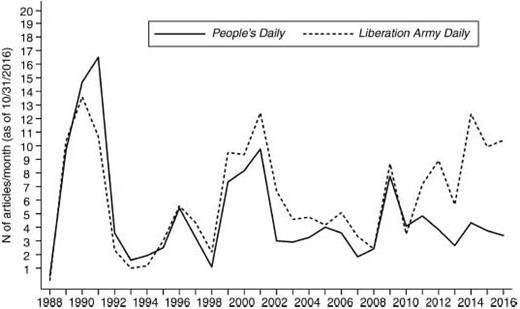
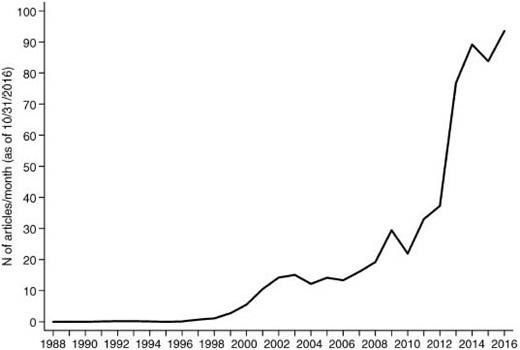
原标题 Is Chinese Nationalism Rising? Evidence from Beijing,载于 International Security 期刊第41卷第3期,7~43页。
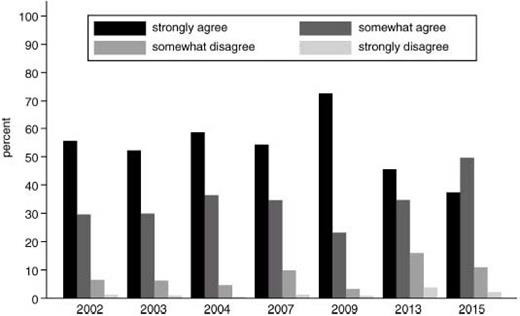
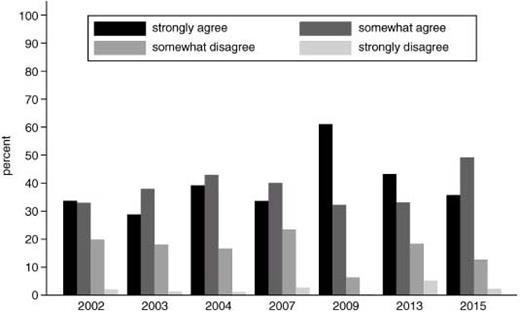
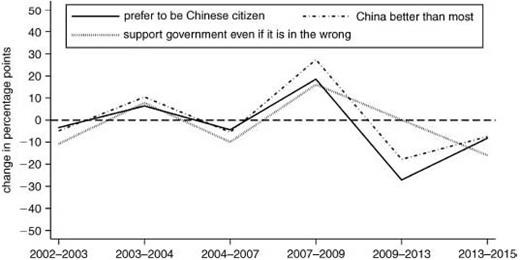
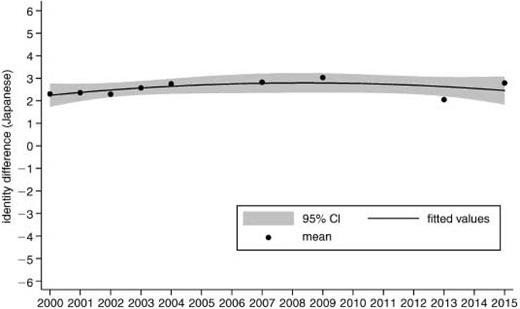
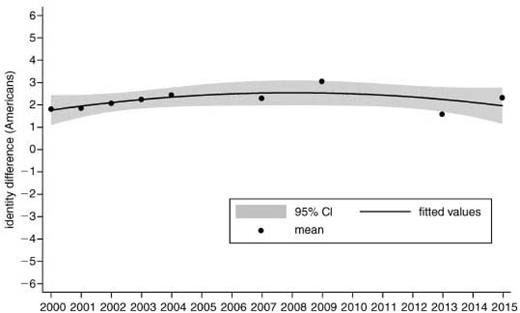
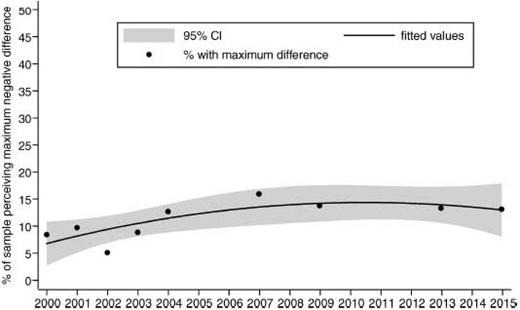
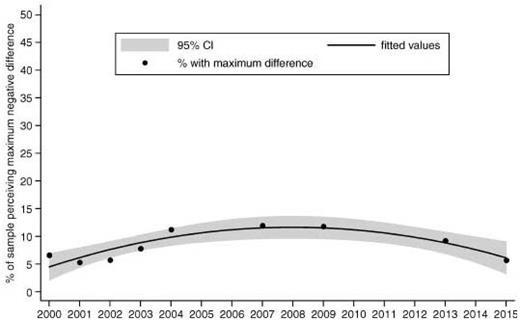
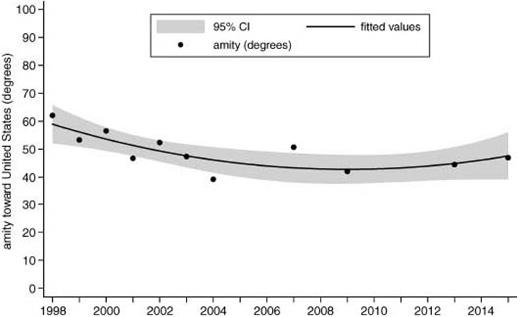
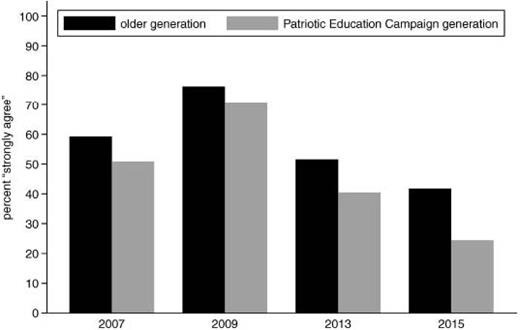
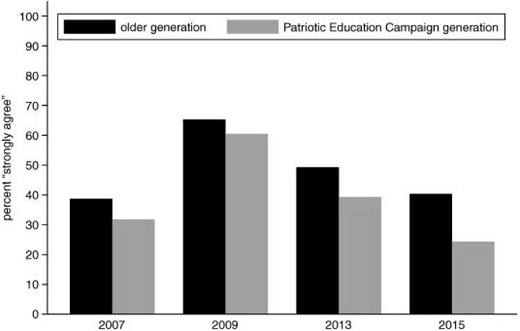
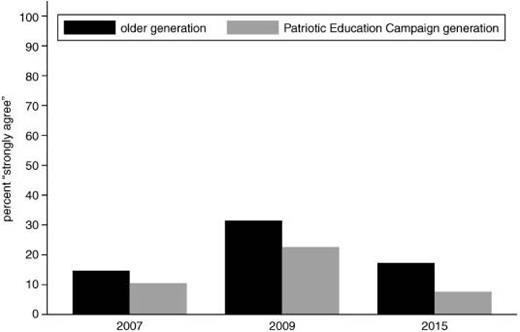
分析家们常声称,20世纪90年代以来“崛起的民族主义”(Rising nationalism)——特别是在中国青年中的民族主义思潮——是迫使中国领导层在一系列外交政策问题上采取更强硬立场的重要推动力量。“崛起的民族主义”也是“自信的中国”叙事中的一个元素,它将中国的“战狼外交”策略泛化为是“中国对由美国主导的自由主义国际秩序的不满和挑战”。但这种说法准确吗?对北京居民1998年至2015年的调查数据表明,民众民族主义情绪上升的说法在经验上是不准确的。这一发现意味着,在解释中国的“战狼外交”时,可能还有其他更重要的因素,如精英观点、高层领导人的个人偏好、国家安全博弈、组织利益等。
-
Vanessa Fong, “Filial Nationalism among Chinese Teenagers with Global Identities,” American Ethnologist, Vol. 31, No. 4 (November 2004), pp. 631–648.
-
William A. Callahan, “History, Identity, and Security: Producing and Consuming Nationalism in China,” Critical Asian Studies, Vol. 38, No. 2 (2006), pp. 179–208.
-
Tang Wenfang and Benjamin Darr, “Chinese Nationalism and Its Political and Social Origins,” Journal of Contemporary China, Vol. 21, No. 77 (2012), pp. 811–826.
-
Brian C. Rathbun, “Chinese Attitudes toward Americans and Themselves: Is There a Relationship?” in Alastair Iain Johnston and Shen Mingming, eds., Perception and Misperception in American and Chinese Views of the Other (Washington, D.C.: Carnegie Endowment for International Peace, 2015), pp. 9–21.
-
Peter Hayes Gries, “Tears of Rage: Chinese Nationalism and the Belgrade Embassy Bombing,” China Journal, July 2001, pp. 25–43.
-
James Leibold, “More Than a Category: Han Supremacism on the Chinese Internet,” China Quarterly, September 2010, pp. 539–559.
-
See James Reilly, Strong Society, Smart State: The Rise of Public Opinion in China's Japan Policy (New York: Columbia University Press, 2012); Jessica Chen Weiss, Powerful Patriots: Nationalist Protest in China's Foreign Relations (Oxford: Oxford University Press, 2014); Hao Yufan and Lin Su, eds., Zhongguo waijiao juece: kaifang yu duoyuande shehui yinsu fenxi [Chinese foreign policy making: Societal forces in Chinese foreign policy making] (Beijing: Chinese Academy of Social Sciences, 2007); and Wang Jun “Wangluo minzuzhuyi yu Zhongguo waijiao” [Internet nationalism and China's diplomacy] (Beijing: Chinese Academy of Social Sciences, 2011).
-
Zhu Tianbiao, “Nationalism and Chinese Foreign Policy,” China Review, Vol. 1, No. 1 (Fall 2001), pp. 1–27.
-
Jia Qingguo, “Disrespect and Distrust: The External Origins of Contemporary Chinese Nationalism, Journal of Contemporary China, Vol. 14, No. 42 (February 2005), pp. 11–21.
-
Yu Zhiyuan and Zhao Dingxin, “Differential Participation and the Nature of a Movement: A Study of the 1999 Anti-U.S. Beijing Student Demonstrations,” Social Forces, Vol. 84, No. 3 (March 2006), pp. 1755–1777. Yu and Zhao's analysis also underscores why using the frequency of demonstrations against foreign targets (Japanese or American symbols, property, or both) may not be a valid measure of nationalism across time. The motivations for participation can vary. Even assuming, however, that a primary motive is nationalism, there is a potential selection problem: people with high levels of nationalism are more likely to participate in these kinds of demonstrations than those with lower levels of nationalism. Counting only the actions of those with high levels of nationalism ignores those who do not participate, possibly because of their lower levels of nationalism. This possibility biases estimates of levels of nationalism upward. In addition, demonstrations are often reactions to some exogenous event. Thus, overall societal levels of nationalism could be constant, or even declining, but the exogenous shock may be sufficient nonetheless to mobilize small numbers of those with high levels of nationalism. The frequency of demonstrations may not reflect rising nationalism as much as the changing frequency of exogenous events.
-
Yu Zhiyuan and Zhao Dingxin, “Differential Participation and the Nature of a Movement: A Study of the 1999 Anti-U.S. Beijing Student Demonstrations,” Social Forces, Vol. 84, No. 3 (March 2006), pp. 1755–1777. Yu and Zhao's analysis also underscores why using the frequency of demonstrations against foreign targets (Japanese or American symbols, property, or both) may not be a valid measure of nationalism across time. The motivations for participation can vary. Even assuming, however, that a primary motive is nationalism, there is a potential selection problem: people with high levels of nationalism are more likely to participate in these kinds of demonstrations than those with lower levels of nationalism. Counting only the actions of those with high levels of nationalism ignores those who do not participate, possibly because of their lower levels of nationalism. This possibility biases estimates of levels of nationalism upward. In addition, demonstrations are often reactions to some exogenous event. Thus, overall societal levels of nationalism could be constant, or even declining, but the exogenous shock may be sufficient nonetheless to mobilize small numbers of those with high levels of nationalism. The frequency of demonstrations may not reflect rising nationalism as much as the changing frequency of exogenous events.
-
Allen Carlson, “A Flawed Perspective: The Limitations Inherent within the Study of Chinese Nationalism,” Nations and Nationalism, Vol. 15, No. 1 (January 2009), p. 25.
-
Li, “China's Rising Nationalism and Its Forefront.”
-
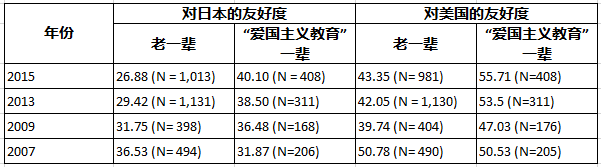
The BAS is administered by the Research Center for Contemporary China at Peking University. It began in 1995 and was modeled on the Detroit Area Study. The survey is mainly focused on attitudes toward city and local governance performance. Over the years, however, it has included some questions about national government performance, consumer confidence, political reform, and foreign policy. Since 1998 I have collaborated with the designers of the BAS in fielding questions about foreign policy and international affairs. From 1995 to 2007, the BAS sampled Beijing residents from the main urban districts, using probability proportional to size sampling procedures. Since 2007 it has used GPS sampling so as to increase the sample size and to include urban and rural registered residents of Beijing and unregistered residents living in the larger municipal area. On BAS sampling, see Hao Hongsheng, “The Sampling Design and Implementation for the 1995 Beijing Area Study,” Peking University, 1996; and Pierre F. Landry and Shen Mingming, “Reaching Migrants in Survey Research: The Use of the Global Positioning System to Reduce Coverage Bias in China,” Political Analysis, Vol. 13, No. 1 (Winter 2005), pp. 1–22. The BAS data used in this study are freely available from me for academic research purposes. As far as I am aware, the BAS is the only available time-series survey of ordinary Chinese people's views of a range of foreign policy issues such as military spending, foreign aid, trade preferences, amity, and nationalism. The Japanese nongovernmental organization, Genron NPO, has gathered times-series data on Chinese views of Japan. Although the Genron NPO survey includes detailed and useful questions that address the constitutive elements of these views, the primary attitudinal question concerns favorability—a vague concept that is hard to interpret and that does not measure nationalist sentiments. For the Genron NPO studies, see http://www.genron-npo.net/en/opinion_polls/. The Pew Research Center has also asked favorability questions across several years. Its Global Trends and Attitudes survey of Chinese opinion of Japan includes two separate years (2006 and 2016) with questions about stereotypes of the Other (in this case, Japanese people). The stereotype questions, however, do not ask about stereotypes of Self, so it is not possible to generate perceptions of difference and therefore measures of ethnocentrism. See Bruce Stokes, “Hostile Neighbors: China vs. Japan” (Washington, D.C.: Pew Research Center, September 2016), http://www.pewglobal.org/2016/09/13/hostile-neighbors-china-vs-japan/.